SYSTEM // LOADING
BIDQUEST // 2026
GRID // 1280px
BIDQUEST // 2026
Zero manual search • 100% Free
Learn how to read government tender documents in India: NIT, eligibility, technical specifications, BOQ, EMD, evaluation, corrigenda and submission checklist.
A tender document is not merely a price request. It is a package of instructions, commercial conditions, eligibility tests, specifications and contractual commitments. For Indian MSMEs, contractors and first-time bid teams, the fastest way to lose time is to start preparing certificates or filling in the bill of quantities before deciding whether the business can actually comply.
This guide explains how to read the document systematically, using examples and a reusable checklist. Tender formats differ between the Central Public Procurement Portal (CPPP), the Government e-Marketplace (GeM), state portals and individual departments. The actual tender and any corrigenda control your bid, not a generic checklist.
Start from the official eProcurement portal or the issuing buyer's published procurement website. Save the notice inviting tender (NIT), bid document, specifications, schedules, drawings, standard forms, BOQ files, and all amendments. Keep the original filenames so your team can match an instruction to its source.
Check whether the procurement is for goods, works or services. This matters because eligibility evidence, measurement rules and contract conditions may differ. The Department of Expenditure publishes distinct procurement manuals; the Manual for Procurement of Goods, Second Edition 2024 is useful background for central government goods procurement, but it does not replace the conditions in a particular tender.
Before reading dozens of pages, create a front sheet with the tender reference, buyer, scope, portal, submission deadline, bid-opening information, pre-bid query date, document links and amendment history. Verify time zones and portal cutoffs. Do not assume an extension has been granted unless the issuing authority posts one.
The NIT is your navigation page. It normally identifies the buyer, procurement title, location, approximate scope and key dates. Read it twice: once for the opportunity, then again for the actions you must perform.
| Question | Where to look | What to record |
|---|---|---|
| What is being bought? | NIT and scope | Deliverables, quantity and location |
| Can we submit? | Eligibility clauses | Every mandatory threshold |
| When is the deadline? | Tender schedule and corrigenda | Final published time |
| Is a pre-bid meeting offered? | Tender schedule | Date and query instructions |
| How are bids submitted? | Instructions and portal notice | Covers, formats and upload method |
| Is a payment or security required? | NIT and commercial conditions | Amount, method and exemption evidence |
An NIT summary may omit important qualifications. Treat it as the starting point, then cross-check every row against the detailed conditions.
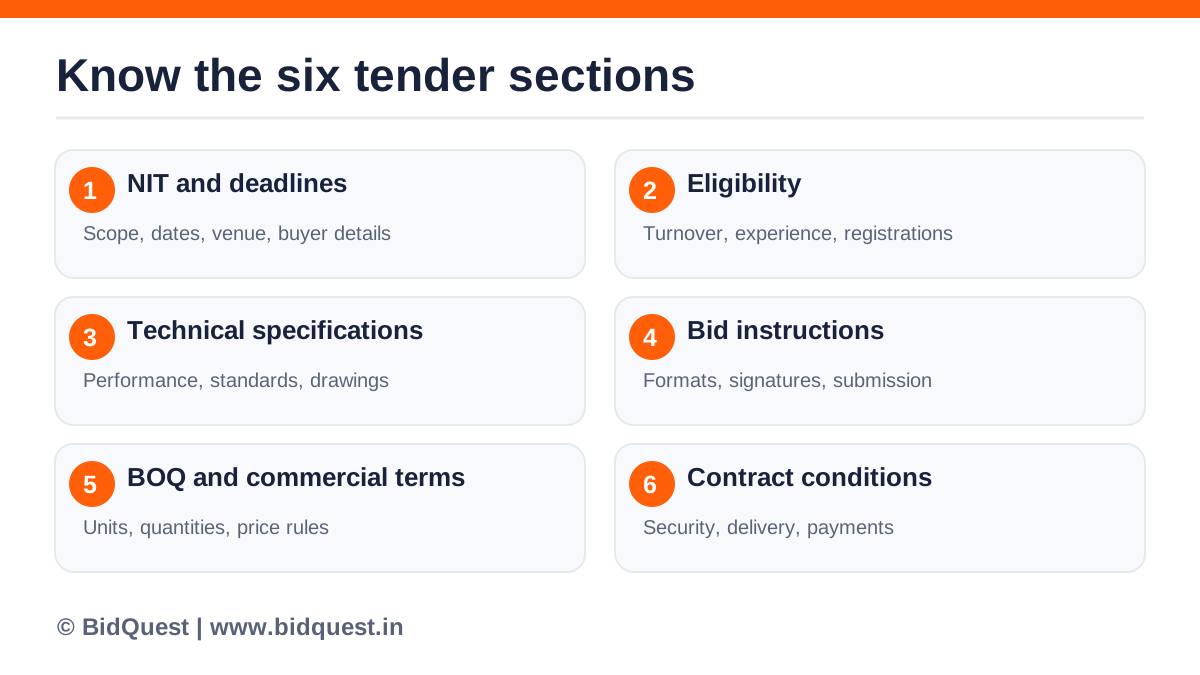
Eligibility is a gate, not a suggestion. Look for required registrations, prior experience, turnover, financial documents, manufacturer authorisation, certifications, technical capacity and bid-specific declarations. Put each mandatory condition in a spreadsheet and add a column for the clause reference and evidence available.
For instance, a hypothetical tender might ask for evidence of three completed similar contracts and a particular turnover threshold. That is only an example, not a universal rule. If your company has two qualifying projects, do not assume an MSME registration automatically removes the missing requirement. Check the specific tender wording and any formally applicable exemption or relaxation.
Where a tender permits consortiums, joint ventures or subcontractors, check whose credentials may be counted and which forms must be signed by each party. A partner's credentials are not automatically usable in every bid.
Also check whether the tender demands documents valid on a particular date. A certificate that exists today but expires before the date specified in the tender may be insufficient. Resolve ambiguous conditions using the designated pre-bid clarification process, not by guessing.
Technical specifications explain the buyer's actual requirement. Depending on the tender, this may include performance parameters, materials, testing, service levels, installation obligations, drawings, standards, warranty or post-supply support. A product name or broad description rarely tells the whole story.
For every specification, note whether your offer complies, where supporting evidence appears, and whether a deviation is permitted. Use three working statuses: Complies, Needs clarification, and Does not comply. Do not silently substitute a different specification simply because your product is close.
For a service contract, technical compliance may mean staffing levels, service response time, coverage hours, reporting, equipment and replacement obligations. For works, it may mean drawings, site conditions, measurement methods and material specifications. Ask the technical owner to confirm each row before the commercial team quotes.
If the buyer provides an approved makes list, drawings or testing format, read the notes and annexures. A single overlooked qualifier may change what must be offered.
Instructions to bidders describe the submission process. They may prescribe two-cover or other envelope structures, digital signatures, file formats, page limits, document naming, declaration wording and when particular information may be disclosed.
Never put price information in a technical cover if the tender prohibits it. Check whether the buyer asks for a specific signed undertaking or an unmodified form. An otherwise strong offer can become non-responsive when mandatory submission instructions are missed.
CPPP provides a Bidders Manual Kit covering registration, document uploads, online bid submission, withdrawal, re-submission and BOQ preparation. These manuals explain portal operations. The tender itself determines what you must submit for a particular opportunity.
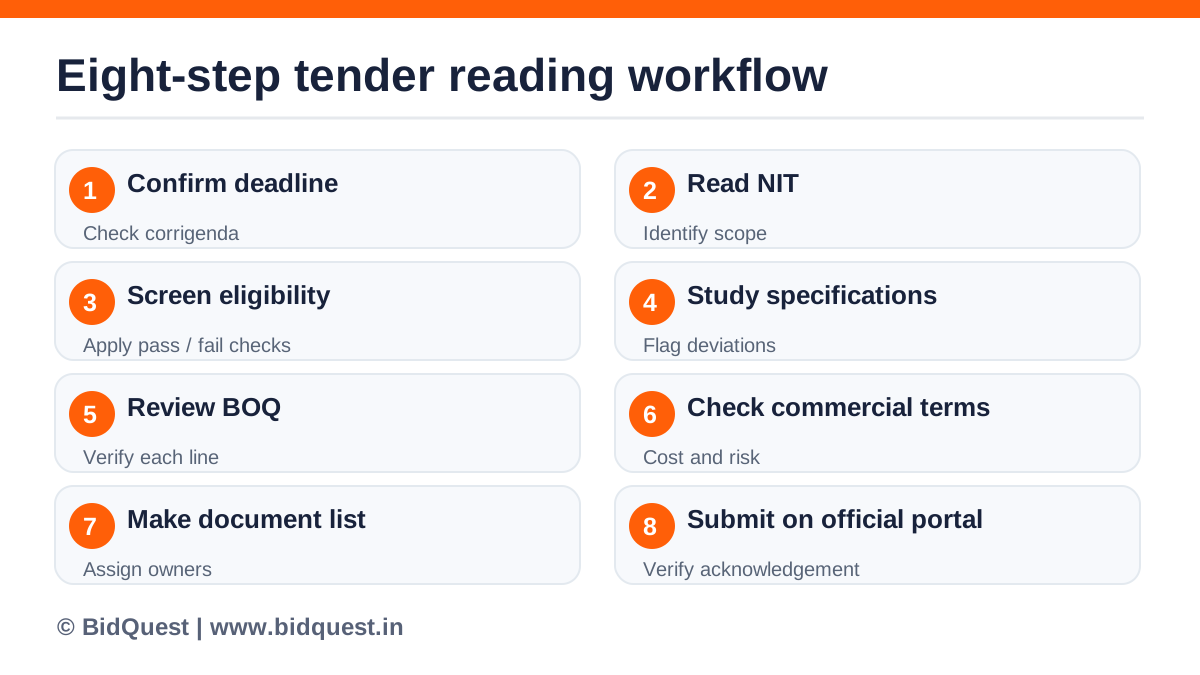
The bill of quantities (BOQ) or price schedule connects your quote to what the buyer will evaluate. Read the column headings and instructions before typing numbers.
Check units of measurement, quantities, included accessories, taxes, transport, packing, installation, warranty, labour and any other inclusions. A per-unit price and a lump-sum price cannot be compared safely unless you understand what each covers.
For a hypothetical supply of 100 units, quoting ₹1,000 each results in a base amount of ₹1,00,000. That calculation is straightforward, but the tender may specify whether GST, delivery or installation should be included or shown separately. Follow the price schedule's own rule; do not assume all tenders treat taxes in the same way.
Do not alter protected BOQ cells, formulas or workbook structure where the buyer directs you not to. Compare the saved and final-uploaded versions. Have a second person review unusual low or high figures and decimal placement.
Some procurements evaluate the lowest responsive price; others apply a stated quality-and-cost, lifecycle-cost or other evaluation method. Only the published evaluation provisions tell you how your financial bid will be compared.
Find the precise clauses for tender fees, earnest money deposit (EMD) or bid security, exemptions, performance security and any post-award guarantees. Record the amount, acceptable form, beneficiary, deadline, validity, return and forfeiture conditions.
Do not assume a universal EMD percentage or automatic MSME exemption. Applicability may depend on the procurement type, government instructions, bidder status and tender wording. If the tender allows an exemption, identify the evidence and declaration needed to claim it. If it requires a bid securing declaration or specific instrument instead, follow that instruction.
Keep security requirements separate from contract payments. Bid security concerns participation in the procurement; performance security relates to carrying out an awarded contract. They have different triggers and conditions.
For current background on central goods procurement, consult the Department of Expenditure's 2024 procurement manual, especially its provisions concerning bidding documents and securities. Check the exact tender clause before committing funds.
A successful bidder may be required to deliver goods or services under conditions that were already included with the tender. Read them before deciding your price.
Look at delivery milestones, acceptance tests, inspection, payment timing, retention, warranty, defects liability, liquidated damages, insurance, taxes, change control, dispute handling and termination. For site work, consider access restrictions, drawings and responsibilities for permits and utilities where specified.
One practical test is to ask: What would this obligation cost if everything goes wrong? A tight delivery window, long warranty and penalty exposure can turn an attractive-looking order into an unmanageable project.
Where the contract makes a buyer's approval or inspection a payment condition, record what evidence will be required. The sales estimate should reflect that working-capital timeline.
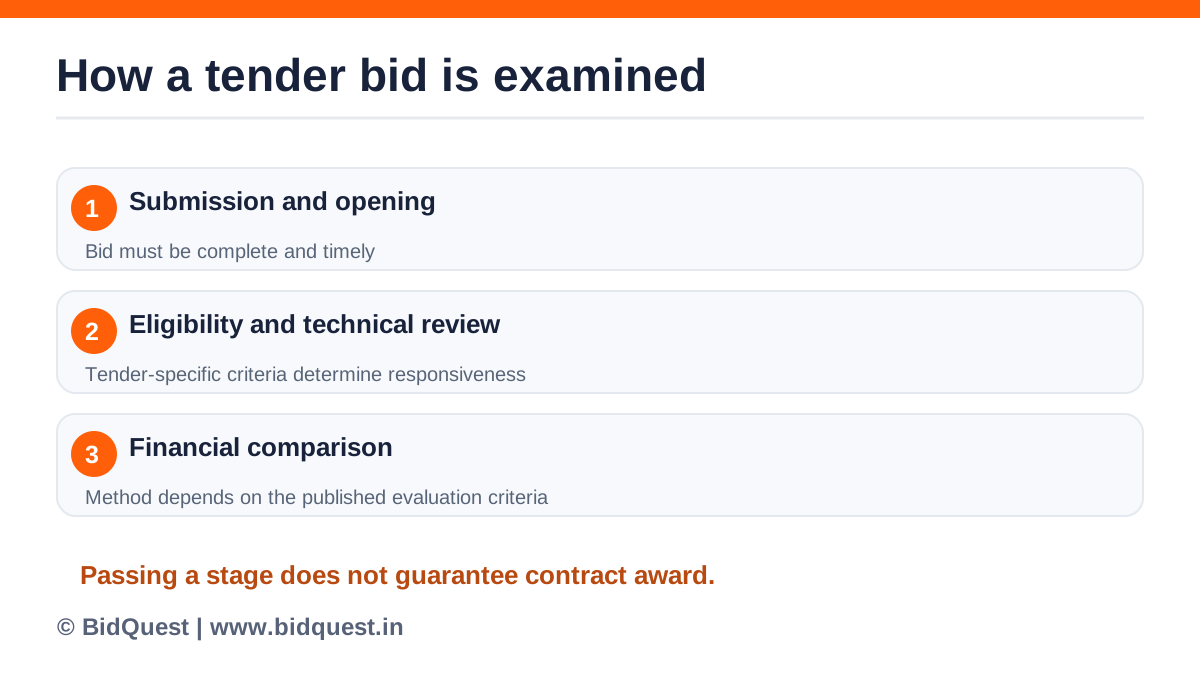
Find the section headed evaluation criteria, bid evaluation, selection methodology or qualification. Map the order in which the buyer may assess responsiveness, technical compliance and price. This is a tender-specific process.
A bid can be submitted on time and still fail a mandatory eligibility or technical requirement. Conversely, meeting the minimum conditions does not guarantee an award. The tender may contain tie-breaking provisions, preference rules or procedures for clarifications; these must be read as written.
Avoid building your submission around an assumption that the lowest price always wins. If the buyer states a technical threshold, qualifying score, quality-and-cost selection method or other criterion, document how your proposal addresses it.
A corrigendum may change a deadline, technical specification, eligibility condition, BOQ or document form. Portal listings can show many successive amendments. Your bid team needs a way to identify the latest applicable set.
Keep an amendment register with the issue date, affected clause, old wording, replacement wording and owner responsible for updating the bid. After any corrigendum, rerun eligibility and pricing checks rather than simply adding the document to your folder.
Where the original tender conflicts with a later formal amendment, assess the amended terms carefully and follow the authority's published directions. Pre-bid meeting notes should also be examined to see whether they formally change the tender or merely clarify it.
A bid prepared against an outdated BOQ or old deadline is avoidable. Make amendment monitoring part of the daily submission plan.
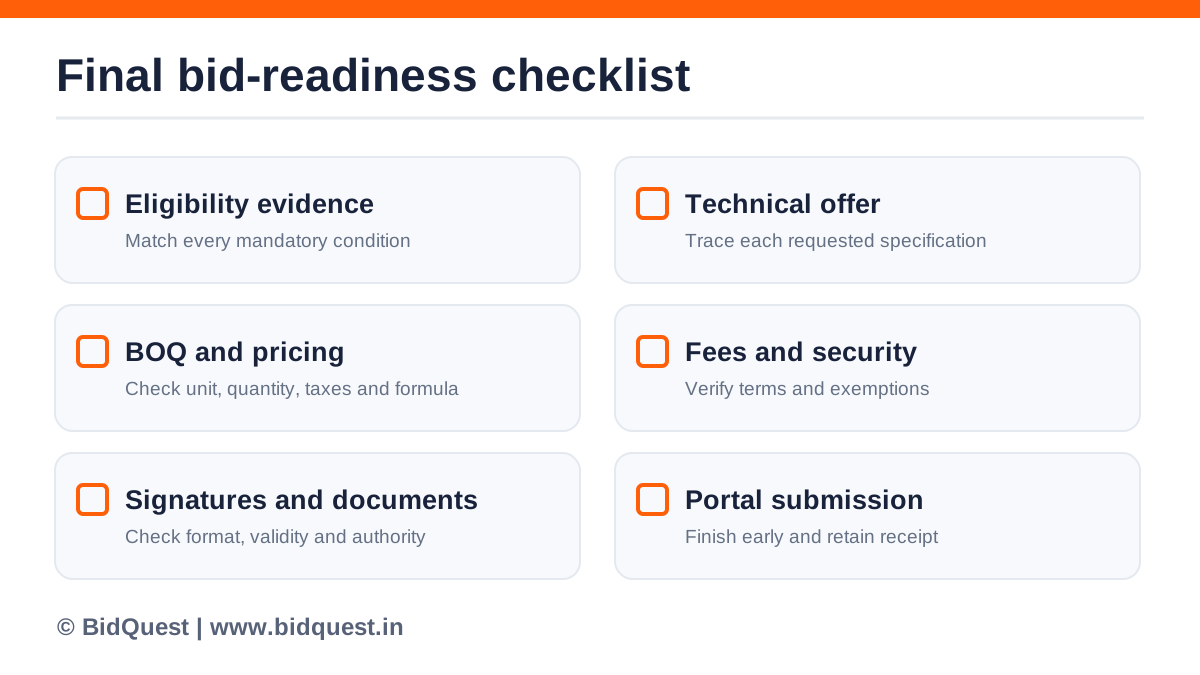
Use a single checklist shared across sales, operations, finance and the person handling portal submission. Each item needs an owner and a final verification point.
| Final check | Evidence of completion |
|---|---|
| Tender reference and latest corrigendum checked | Saved current documents |
| Mandatory eligibility confirmed | Clause-to-document matrix |
| Technical specifications reviewed | Compliance matrix and annexures |
| BOQ completed as directed | Reviewed commercial file |
| Security or valid exemption addressed | Tender-specific proof |
| Forms and signatures complete | Signed final documents |
| Portal upload and submission finished | Official acknowledgement |
The person uploading should confirm the correct files, the intended covers and the final portal acknowledgement. Starting early helps manage file-size issues, digital-signature problems and network interruptions. A draft saved on the portal is not necessarily a completed submission.
Imagine an MSME that finds a tender to supply and install 40 industrial pumps. The NIT looks attractive, and the sales team already knows the unit price. A disciplined reading process reveals additional work:
First, the eligibility section requires particular past-supply evidence. The team checks whether its completed orders match the stated definition rather than counting every pump sale. Second, the technical annexure specifies performance at a particular operating point, so an engineer confirms the proposed model against the data sheet. Third, the schedule requires commissioning and operator training, which are included in costing.
Fourth, the BOQ sets out how the unit rate and installation line are to be quoted. Fifth, the contract requires inspection before acceptance, changing the likely cash-collection timeline. Finally, the tender is amended to extend the delivery period. The team updates both its project plan and compliance register.
All quantities and conditions in this example are illustrative. The point is that the initial headline quantity did not capture the entire bidding obligation.
Reading only the NIT. The short notice can miss detailed eligibility, technical and contractual conditions.
Starting with price. You may spend hours quoting a bid for which your business does not meet a mandatory condition.
Treating all tenders alike. Formats differ across buyers, procurement categories and portals.
Assuming a waiver applies. Registration or enterprise status alone is not proof that a particular fee, security or experience clause is waived.
Ignoring contract conditions. A profitable-looking price may not cover installation, warranty, penalties or delayed acceptance.
Missing amendments. A corrigendum can supersede the document on which the original bid was based.
Submitting at the last minute. A correct offer still needs successful submission and acknowledgement through the official portal.
No. It helps you screen the opportunity, but a final go/no-go decision should follow a review of detailed eligibility, specifications, BOQ, submission instructions, amendments and contract conditions.
Use the clarification or pre-bid query process specified by the buyer. Keep a written record of the question and the officially published answer. Do not rely on an informal assurance where the tender calls for formal clarification.
That depends on the specific tender. Some procurements may allow relevant private-sector experience or relax stated criteria, while others prescribe different conditions. Read the mandatory eligibility and any applicable preference or relaxation clauses carefully.
No. An offer must meet applicable eligibility and responsiveness requirements, and the published evaluation method controls the result. The buyer also follows its award procedures.
Submit through the portal or channel specifically named by the issuing authority. For CPPP procurements, use the official eProcurement portal. BidQuest is not the government submission portal.
Download the original documents, create a clause-by-clause compliance tracker, resolve open questions and allocate an owner to each requirement. Review the official portal again immediately before submission for corrigenda or other notices.
For tender discovery, you can search opportunities on BidQuest, then open the relevant official tender and verify its current conditions. Use the issuing authority's portal for registration, clarification, document submission and contract actions. BidQuest does not award contracts or guarantee qualification.
Department of Expenditure, Ministry of Finance. Accessed 9 Oct 2026.
National Informatics Centre / CPPP. Accessed 9 Oct 2026.
Provisional accounts are acceptable only if the applicable tender requirements permit them on the relevant basis.
Read the guide
Whether missing material can be requested or supplied after opening depends on the actual shortfall and clarification rules.
Read the guide
Quantity changes depend on the contract's actual variation or option provisions, including permitted limits, rates, timing and authority.
Read the guide