SYSTEM // LOADING
BIDQUEST // 2026
GRID // 1280px
BIDQUEST // 2026
Zero manual search • 100% Free
Review women-owned MSE procurement claims with checks for enterprise category, ownership, current records, policy scope and tender evidence.
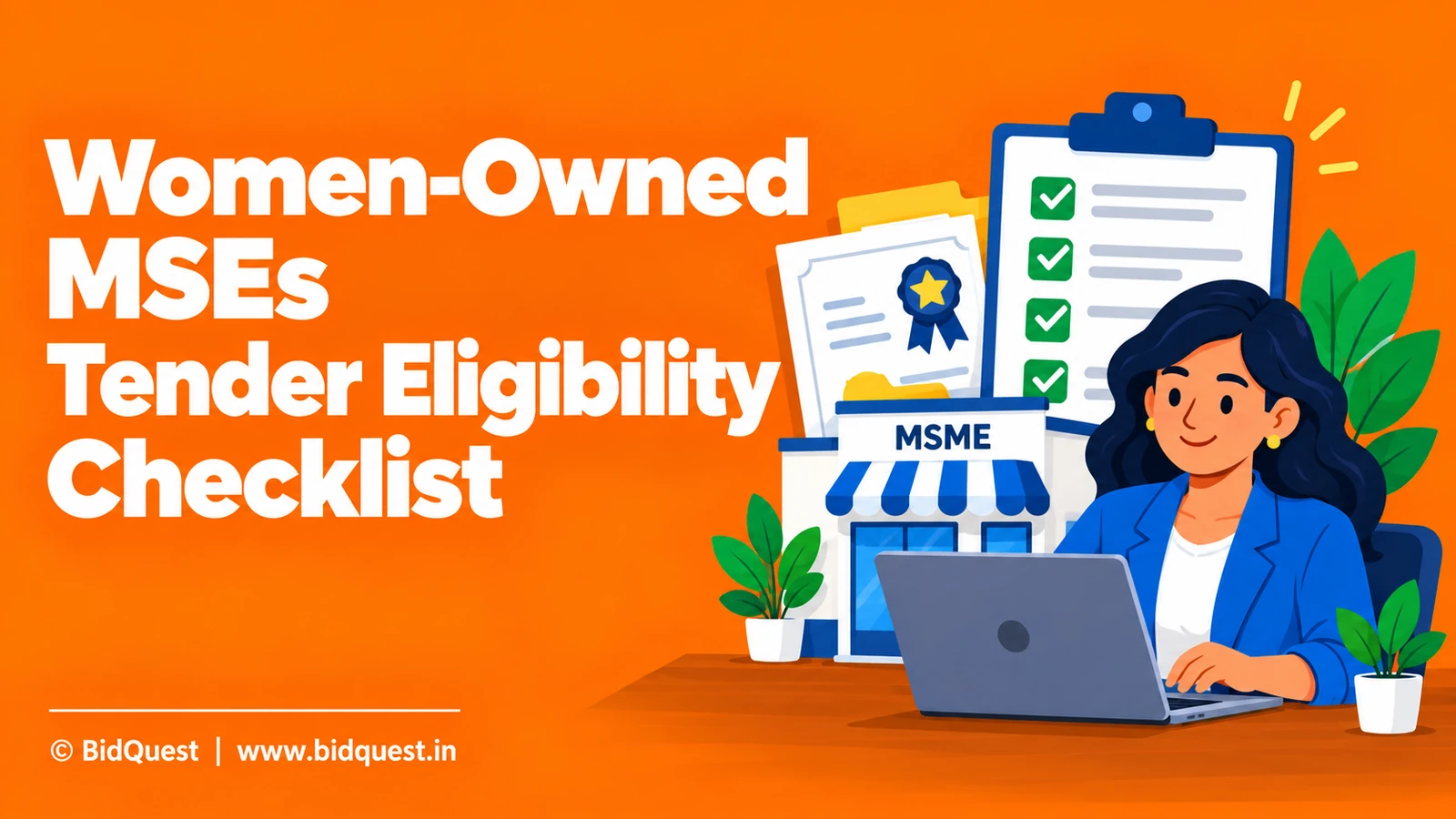
Official Ministry of MSME guidance describes the central MSE procurement objective and the earmarking for women-owned enterprises. An annual procurement objective is not a guarantee that a particular business will receive an individual contract. Official MSME guidance.
This guide provides an original evidence workflow. It does not determine an entity's eligibility or create one ownership rule for every programme and procurement.

Confirm the bidder's legal identity, activity and current micro or small enterprise status relevant to the claim. Do not use MSME and MSE interchangeably without checking the policy.
Record the actual certificate and verification route. An old scan may not explain a current change in classification, name or activity.
Keep registration, seller-account readiness, ownership and technical qualification as separate checks. One completed task does not automatically establish the others.
Ask the appropriate reviewer to resolve consequential applicability questions before the final declaration is prepared.

Read the specific policy or programme definition and entity-specific evidence requirements. Do not substitute an informal description such as women-led, woman director or woman employee for the stated ownership basis.
A business can have meaningful women leadership while needing a separate review of a procurement ownership category. Describe both accurately.
If ownership thresholds or control provisions matter, have a qualified adviser apply the actual current definition to the enterprise's records.
Do not assume a requirement from a state startup programme establishes the same treatment under another MSE procurement provision.

| Review area | What to establish |
|---|---|
| Bidder | Correct enterprise and legal identity |
| Category | Relevant micro/small classification |
| Ownership | Applicable definition and authentic records |
| Activity | Goods or services actually produced/provided |
| Policy | Scope and specific benefit or treatment |
| Tender | Claim method and required supporting documents |
| Dates | Current position and relevant eligibility time |
Use the official list for mandatory evidence. The table is an organisation method, not a universal document requirement.

An annual target, a purchase preference, a fee treatment and a security exemption are different issues. Create one row for each benefit the business intends to claim.
Identify its policy basis, tender treatment, supporting evidence and status. Do not use a broad “women-owned exempt” label.
If only one claim is confirmed, do not assume every other cost or qualification condition is waived. Finance needs the actual payment position and operations still needs a feasible scope.
Record unresolved questions before spending significant effort on a bid.
Use records relevant to the actual entity type and reviewed definition. A proprietorship, partnership and company may need different evidence.
If an investment or ownership transaction occurred, check its effect before reusing an earlier declaration. Preserve genuine records and obtain qualified advice where continuity is consequential.
Do not change a declaration merely to fit a desired benefit when it contradicts the actual structure.
Keep a short internal conclusion explaining what supports the claim and what remains uncertain. The uploader should not interpret ownership law at the final screen.
A small company has previously described itself as women-owned. After an investment transaction, its shareholding records change, while an older tender folder still contains the previous declaration.
The reviewer compares current records with the applicable definition and relevant date. It checks whether official information or a tender claim needs updating.
The company does not automatically reuse the old statement because it was accepted elsewhere. It records the supported position and obtains advice if the treatment is unclear.
The example illustrates current evidence management, not a legal conclusion about a particular ownership transaction.
Identify the buyer and governing framework. A central policy reference should not be applied identically to every state, local or sector procurement without review.
Read whether the invitation provides the relevant treatment and how it is claimed. If ambiguity remains, ask a specific formal question naming the condition and proposed evidence.
Distinguish a request for confirmation from a request to amend the tender. Do not act as though a requested relaxation has already been granted.
Retain the formal answer with the qualification matrix.
Review product configuration, service resources, experience where required, supplier arrangements, licences and financial records. Use authentic evidence belonging to the permitted bidding structure.
Do not expect ownership positioning to answer an unrelated technical requirement. A compliant offer still needs a clear delivery method and sustainable price.
Ask operations to confirm capacity and finance to confirm cash, securities and billing assumptions.
The strongest opportunity is one that matches the enterprise's actual evidence and operating capability, with any legitimate benefit applied accurately.
A women-owned MSE considers a procurement and intends to claim a specific MSE security treatment and an ownership-related policy treatment.
The reviewer creates separate rows. The security row checks enterprise category, policy and evidence. The ownership row checks the relevant definition, records and tender mechanism.
If one is unresolved, management sees its effect on the decision. Finance models any required payment rather than assuming all participation cash is zero.
Operations independently confirms delivery. The example shows why several relevant policy concepts should not become one blanket guarantee.
Identify official programmes or events relevant to the enterprise's task. Confirm current scope, eligibility and application route from the issuing body.
Set a concrete preparation goal: a verified evidence file, a clarified policy question or readiness for an appropriate buyer category.
Do not assume participation in a support event guarantees qualification or an order. Do not treat a consultant's commercial promise as an official decision.
Retain control over the enterprise's accounts and declarations even when external advisers help prepare documents.
Limit access to personal, ownership and financial records according to the task. Use the prescribed official channel for submissions.
A shared evidence index can identify the document and reviewer without exposing every underlying page to unrelated employees.
If an external adviser is involved, define its scope and use verified channels. Avoid sharing permanent account secrets as an administrative shortcut.
Preserve the approved submitted version so future questions can be answered accurately without reconstructing the claim from memory.
When enterprise details, ownership or activity changes, examine affected registrations, profiles, declarations and active bids. Use the relevant official update processes.
Do not alter authentic historical project records. Prepare the appropriate explanation and reviewed continuity evidence where required.
Give active bid coordinators the current-use file set and remove obsolete upload-ready status while preserving the history.
This makes the policy claim reliable across several opportunities rather than dependent on whichever employee has the oldest folder.
After evaluation, record the official qualification and award status. Use disclosed reasons where available and keep interpretation separate.
Do not describe an annual objective as having guaranteed the company a win. Do not infer a policy failure merely because another offer was selected under the applicable process.
If a document issue arises, improve that evidence control. If delivery capacity was weak, refine the target contract size or resource plan.
Use authentic successful performance to build future credentials where permitted.
Have a named person confirm enterprise, ownership, activity, dates, policy scope, tender treatment and declaration. Have technical and finance owners confirm their independent readiness.
If a consequential issue remains unresolved, obtain advice or formal clarification rather than burying it in an appendix.
Keep the decision and submitted evidence together. A good register makes it clear which benefit was claimed, why and using which records.
The purpose is credible participation, not collecting every available certificate or making broad exemption statements.
If the enterprise uses women-led marketing language, review whether it also intends a formal women-owned procurement claim. Explain each description on its actual basis.
A capable woman manager or director may be important to the business, but that role should not be presented as satisfying a specific ownership definition without review.
Give the bid team the supported claim and evidence, not a slogan. Keep declarations consistent with the current records and relevant policy.
This respects the business's real leadership while preventing an unsupported eligibility statement.
Have the competent reviewer confirm category and ownership, then have the coordinator check that the approved file matches the tender and prescribed format.
The reviewer addresses applicability; the coordinator addresses correct submission. These are distinct checks even if one person performs both in a small company.
If personal or ownership records are sensitive, use a controlled file index and authorised access. Do not distribute the entire pack simply to coordinate deadlines.
Retain the submitted version and any official confirmation for later questions.
If an investment, transfer or restructuring is in progress, establish the actual completed facts and relevant eligibility date with qualified advice.
Do not treat a proposed future ownership position as current, or assume a historical statement remains valid after a completed change.
Identify active bids and the applicable notification or correction process. Keep the transaction review separate from a general registration update.
Management should see whether the claim is supported, pending or no longer being made before approving the offer.
After an awarded contract is completed, preserve legitimate acceptance and performance evidence. Review which future tenders permit that record as qualification.
Do not convert policy support, a vendor-development event or a submitted proposal into claimed completed experience.
Use delivery lessons to improve resource, evidence and pricing preparation. Accurate ownership positioning is most valuable when combined with reliable supply or service capability.
The objective is a sustainable procurement business with truthful claims and a growing verifiable history.
Apply the actual ownership definition and evidence requirements.
No. Review the individual procurement's mechanism and evaluation.
Do not assume that. Establish the relevant current definition.
Yes. Verify their basis and supporting records independently.
Review current facts and relevant dates before relying on it.
Prepare a current enterprise-and-ownership evidence register for one opportunity. Explore BidQuest for discovery and confirm the actual policy and tender treatment through official sources.
Ministry of MSME. Accessed 12 Oct 2026.

Understand when MSE bid-security or EMD relief may apply, what documents tenders request, and why registration alone is not a universal exemption.
Read the guide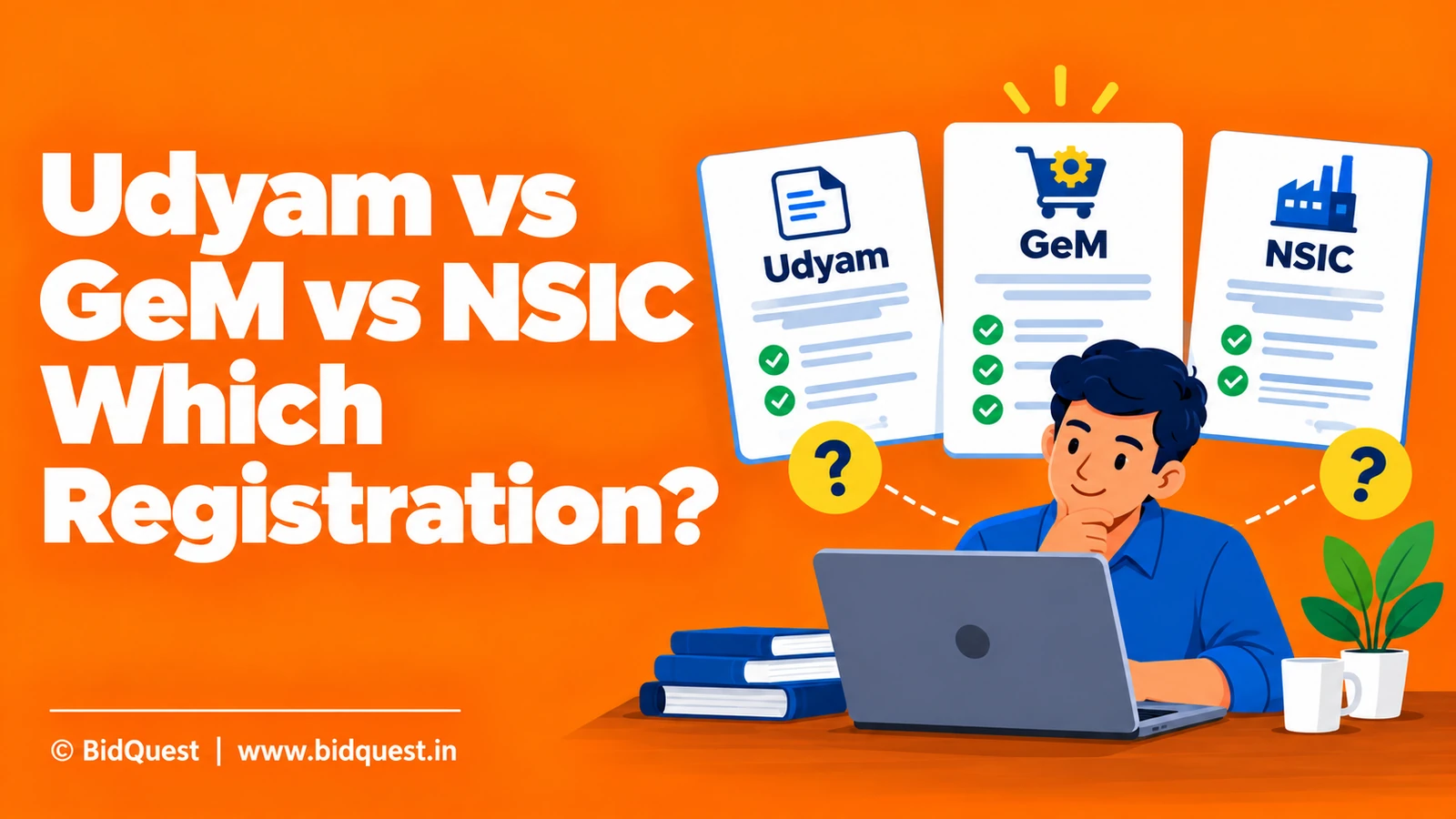
Compare Udyam, GeM seller onboarding and NSIC SPRS for Indian MSE bidders, with a decision matrix, evidence checklist and tender-specific caveats.
Read the guide
Some procurement provisions reserve specified items for relevant MSE sourcing, but the actual current list, product description and applicable buyer framework must support the claim.
Read the guide