SYSTEM // LOADING
BIDQUEST // 2026
GRID // 1280px
BIDQUEST // 2026
Zero manual search • 100% Free
CHECK ELIGIBILITY
Practical guidance on EMD, exemptions, turnover, experience, and the evidence a tender may require.
Some procurement provisions reserve specified items for relevant MSE sourcing, but the actual current list, product description and applicable buyer framework must support the claim.
Read the guide
Tender-fee treatment must be checked separately from EMD exemption and other MSME-related benefits.
Read the guide
An eligible recognised startup should examine the current public-procurement provisions and actual notice for any relevant experience relaxation.
Read the guide
Do not assume that a medium enterprise receives benefits expressly intended for micro and small enterprises.
Read the guide
A new MSE should read whether the applicable procurement permits relaxation of past-turnover conditions and what evidence is needed.
Read the guide
A service business should assess whether the relevant MSE benefit applies to its actual enterprise and the services being procured.
Read the guide
A trader should distinguish general enterprise registration from benefits linked to goods produced or services rendered by an eligible MSE under the applicable policy.
Read the guide
An eligible MSE may have an EMD exemption under the applicable procurement provisions, but the claim must fit the actual enterprise, activity and event.
Read the guide
Experience relaxation must be established from the relevant current provisions and actual tender, not inferred solely from an MSE registration.
Read the guide
Review the actual classification change, relevant dates and any applicable transition provisions before deciding its effect on a tender or ongoing contract.
Read the guide
Women-owned enterprises should check the relevant current procurement policy, ownership definition and actual tender conditions before claiming special treatment.
Read the guide
An Udyam certificate establishes relevant registration information on its stated basis; it does not automatically prove that the enterprise meets every tender condition.
Read the guide
Do not assume an exemption or preference can be introduced after the bid has been submitted or closed.
Read the guide
Follow the particular portal and tender instructions for claiming MSE treatment and attaching the relevant Udyam evidence.
Read the guide
A startup-recognition record and an Udyam enterprise-registration record answer different questions and should not be treated as the same certificate.
Read the guide
NSIC registration should not be described as compulsory for every government supplier without checking the relevant scheme and tender.
Read the guide
Udyam registration is relevant to establishing MSME status and claiming benefits where the applicable arrangement requires it, but it is not a universal substitute for every tender.
Read the guide
An MSE facing delayed payment should first establish the amount, acceptance or dispute position, contractual due basis and supporting invoice and supply records.
Read the guide
The expression L1 plus 15 percent refers to a price-band concept in the relevant MSE preference framework, subject to its actual conditions and implementation.
Read the guide
Check whether the enterprise's recorded activity accurately describes the goods or services relevant to the claim and what the applicable procurement policy requires.
Read the guide
MSE purchase preference concerns the treatment available under the applicable procurement policy when its conditions are met.
Read the guide
Udyam and NSIC arrangements serve different purposes and should not be treated as interchangeable certificates.
Read the guide
SC/ST-owned MSEs should establish the current applicable policy, qualifying ownership and enterprise status and the evidence required by the actual procurement.
Read the guide
Relevant benefits depend on the applicable procurement framework, enterprise classification, activity and actual notice.
Read the guide
Compare the stated rejection reason with the benefit claimed, the applicable policy and the evidence actually submitted.
Read the guide
Check startup procurement benefits with a clause-based review of recognition, experience, turnover, EMD and technical requirements before bidding.
Read the guide
Review women-owned MSE procurement claims with checks for enterprise category, ownership, current records, policy scope and tender evidence.
Read the guide
Prepare SC/ST-owned MSE procurement evidence, verify ownership and activity, and distinguish annual procurement targets from individual award guarantees.
Read the guide
Review Make in India procurement treatment with checks for applicability, local-content classification, item evidence and the actual preference method.
Read the guide
Prepare a local-content declaration or certificate with checks for the offered item, calculation basis, supplier records, signatory and tender format.
Read the guide
Manage changes to Udyam and business details with an identity reconciliation, affected-account register and review of active bids and exemption claims.
Read the guide
Understand when MSE bid-security or EMD relief may apply, what documents tenders request, and why registration alone is not a universal exemption.
Read the guide
Learn how to read turnover, similar-work, registration, financial and technical eligibility criteria in Indian government tender documents.
Read the guide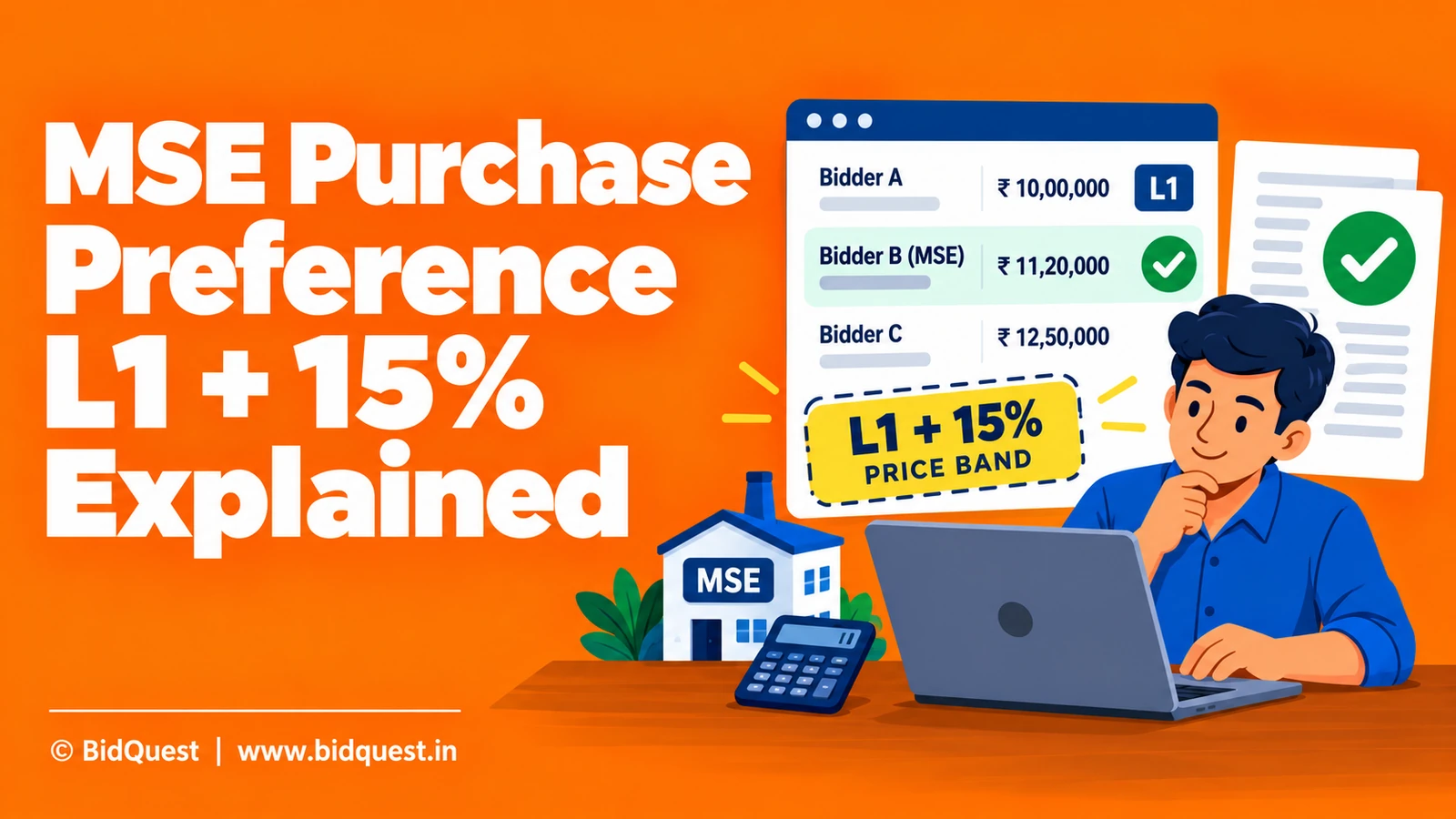
Understand the MSE purchase preference price band, when an eligible MSE may match L1, and why the rule is not an automatic contract award.
Read the guide
A practical guide to invoice evidence, acceptance dates and the MSME delayed-payment route after government supply or service contracts.
Read the guide
Understand when earnest money and performance security arise, how to read tender clauses, and how to budget cash, guarantees and refund timing.
Read the guide
Compare Udyam, GeM seller onboarding and NSIC SPRS for Indian MSE bidders, with a decision matrix, evidence checklist and tender-specific caveats.
Read the guide