SYSTEM // LOADING
BIDQUEST // 2026
GRID // 1280px
BIDQUEST // 2026
Zero manual search • 100% Free
Understand the MSE purchase preference price band, when an eligible MSE may match L1, and why the rule is not an automatic contract award.
This guide is written for Indian suppliers, contractors, MSMEs and bid teams who need a repeatable decision process, not a shortcut around the buyer's rules. The issuing department's live notice, attachments, amendments and portal instructions control every submission. A general procurement manual explains a framework; it does not replace a particular tender. The examples below are hypothetical training examples, not quotations from real government bids.
The main question is MSE purchase preference L1+15%. The answer depends on the exact procurement type, buyer, category, and tender wording. Keep a copy of the original tender with its version and publication date, note the clause number beside every decision, and ask the buyer through the permitted clarification channel where a requirement is unclear. Do not infer eligibility, price preference, contract award, or portal acceptance from this guide alone.
The central MSE policy sets an annual procurement objective for covered central buyers; that does not mean every individual tender must be split into a fixed percentage. The Ministry of MSME describes a 25% annual procurement mandate for central ministries, departments and CPSEs, with specified sub-targets. Its summary also explains a price-band mechanism for eligible MSEs in relevant tenders. These are different ideas. The annual target guides aggregate procurement; the price preference mechanism governs a particular award situation when its conditions are met. A bidder should never calculate expected revenue by multiplying a tender value by 25% without reading the actual tender and applicable policy.
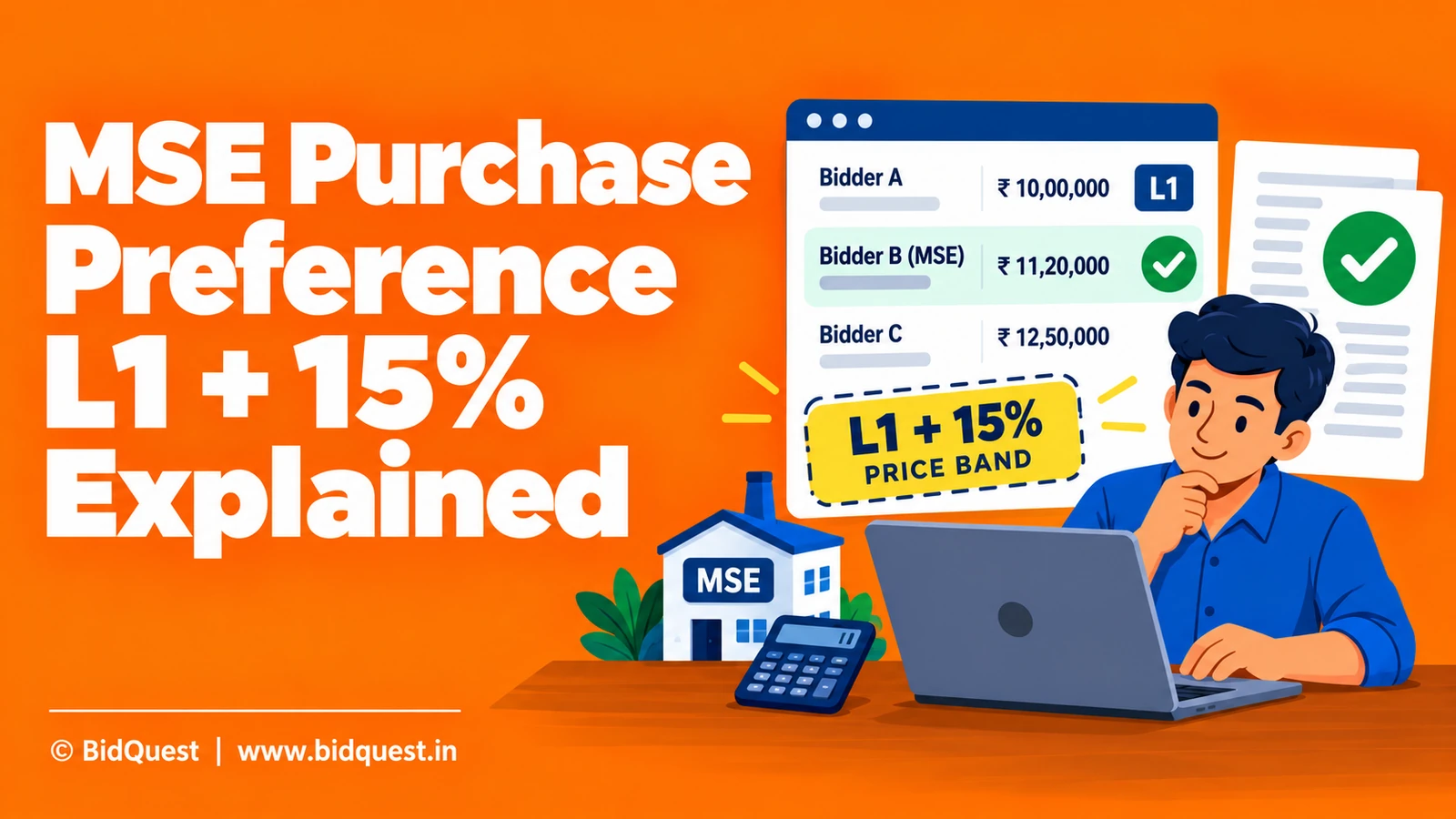
L1 is the lowest evaluated eligible price under the tender's evaluation rules, not necessarily the smallest number visible on an opening screen. Suppose the non-MSE L1 evaluated quote is ₹10,00,000. Fifteen percent of that amount is ₹1,50,000, giving a reference band up to ₹11,50,000. An eligible MSE quoting ₹11,20,000 lies within that illustrative band. It does not automatically win at ₹11,20,000. The policy describes an opportunity, where applicable, to supply a portion by bringing the price down to L1. If the MSE cannot match ₹10,00,000 profitably, the existence of the band does not create a viable contract. Check the tender's unit rates, evaluation basis and allocation rules before applying the arithmetic.

The policy applies to eligible micro and small enterprises in the covered procurement setting, not automatically to every entity described as an MSME. Medium enterprises should not assume the same purchase-preference entitlement. The Ministry's public summary says the policy is for goods produced and services rendered by MSEs and excludes works contracts. A trading business should not infer that reselling a product necessarily qualifies it for the same benefit as producing the product. Check the current policy, the firm's registration details, the actual activity, the buyer type and any tender-specific eligibility evidence. If the bid requests a certificate or declaration, submit the exact document and not an unrelated registration screenshot.
The MSE policy also discusses tender document cost and earnest-money relief, but these are separate benefits with separate conditions. A business may be focused on bid security and miss the commercial question of whether it can match L1. Conversely, a seller may meet a price-band condition but still fail a mandatory technical specification. Create separate rows in the bid matrix for eligibility, bid security, technical responsiveness, evaluated price, and potential purchase preference. This prevents the common error of writing "MSME exemption" beside every clause and assuming it resolves all five issues. Read the original tender and official policy rather than using a single blanket claim.

The buyer may evaluate unit rates, total landed cost, taxes, installation or life-cycle considerations as stated in the tender. The L1 reference must be taken from that published method. A supplier's quoted base price may not be its evaluated price if freight or other elements are included. Where the requirement is divisible, allocation mechanics may differ from an indivisible procurement; do not invent a universal splitting formula. The Department of Expenditure goods manual contains detailed purchase-preference discussions in section 1.11 and bid evaluation guidance in chapter 7. Read those alongside the current Ministry of MSME policy and any later orders.
The commercial team should decide its minimum sustainable price before bid opening. Add materials, labour, packing, freight, warranty, finance cost, overhead and an appropriate risk reserve. If the all-in cost of a supply is ₹9,85,000 and the L1 reference is ₹10,00,000, the apparent contribution is only ₹15,000 before any unmodelled events. A price match might be technically possible but financially unwise. Keep the floor calculation internal and do not share competitor-sensitive information. The goal is to prevent a preference benefit from turning into a loss-making obligation. A policy opportunity is useful only when the supplier can perform the contract.

Maintain the current Udyam details, business identity, product or service activity evidence and any specific tender declarations. Check whether the buyer asks for a date-specific status or additional proof. The Udyam portal publishes classification criteria and updates; verify the enterprise's current category rather than relying on an old certificate printout. If a firm changed its activity, size or legal structure, obtain appropriate professional advice on its eligibility. Where the tender's preference clause is unclear, use the official clarification process early. A last-minute unsupported assertion of MSE status can jeopardise the bid.
Even if an MSE is eligible and agrees to match L1, the actual award depends on the tender's conditions, responsiveness, capacity, quantities and applicable procurement rules. There may be other purchase-preference or reservation policies that interact with the evaluation. Do not promise your sales team a fixed share before receiving a formal award. Once a purchase order is issued, the supplier must meet the same delivery and quality obligations stated in the contract. The preference mechanism is designed to support participation, not to waive contractual performance or create a guarantee of profit.

A hypothetical central goods tender has an evaluated non-MSE L1 price of ₹20,00,000. An eligible manufacturer MSE bids ₹22,50,000. The illustrative L1+15% ceiling is ₹23,00,000, so the MSE is inside the band. It must still check whether the policy and tender allow a matching opportunity for this procurement, what quantity could be allocated and whether it can reduce its price to ₹20,00,000. Its internal cost sheet shows ₹19,60,000 before financing and warranty contingency, so matching leaves a narrow buffer. The bid owner asks finance to calculate the complete cost and operations to confirm delivery capacity. If the order is indivisible or other preference rules apply, the simplistic allocation assumption may be wrong. The team records its conditions rather than declaring that 25% of the order is guaranteed.
| Review point | Evidence to inspect | Practical decision |
|---|---|---|
| Policy coverage | Buyer type, procurement type, current policy | Determine whether preference may apply |
| MSE status | Current Udyam and activity evidence | Confirm eligible classification |
| Price band | Evaluated L1 and tender formula | Calculate illustrative L1+15% |
| Match decision | Cost floor and capacity | Accept only if viable |
| Award share | Specific tender and official decision | Do not promise fixed quantity |
A table is a decision aid, not a substitute for the actual document. Write the tender reference, clause and amendment date against every row in your working copy. If a requirement cannot be verified, mark it unresolved and assign an owner; do not quietly treat it as satisfied.
Treat the checklist as a living record. Assign each line to one person, attach the source file, and record when it was checked. On the final submission day, re-open the official portal to confirm whether a corrigendum, revised schedule, or changed attachment supersedes your saved copy. Keep the submission acknowledgement or contract communication in the tender folder.
The first mistake is confusing a helpful summary with an authoritative instruction. Search results, aggregator cards and internal spreadsheets may omit exceptions or later amendments. The second is assuming that a rule applicable to central government goods procurement applies identically to works, services, state tenders and GeM bids. The third is allowing the commercial team to quote before the technical owner has confirmed scope and acceptance criteria. The fourth is treating an unsigned internal note as evidence that a buyer accepted a deviation. The prevention is straightforward: cite the live tender clause, preserve the original file, and use written official clarification when necessary.
BidQuest is a private SaaS tender-discovery and review aid, not GeM, CPPP, a state e-procurement portal, or a government authority. Its public website describes tender search and matching features. You can use BidQuest to explore potentially relevant opportunities and then carry out the checks in this article against the buyer's original documents. BidQuest does not issue eligibility certificates, grant exemptions, approve bid documents, submit an official bid for you, or guarantee a tender award. For a useful starting point, see our published guides to finding government tenders and reading tender documents.
Optional next step: Explore tender opportunities on BidQuest, then verify the original notice on the official procurement portal.
No. In the described mechanism, the eligible MSE may be asked to match the L1 price to supply an applicable portion.
No. Check micro or small status, activity, buyer and tender scope; medium status is not equivalent.
The Ministry of MSME summary says works contracts are outside this policy’s scope.
No. It is an annual procurement target for covered buyers, not an individual award guarantee.
The following primary sources were checked on 11 October 2026. The named section or course identifies where to verify the relevant principle. Always check later amendments and the live tender.
Editorial status: draft, not approved for publication. Technical and legal conclusions must be checked against the applicable tender and current government instructions before release.
Development Commissioner, Ministry of MSME. Accessed 11 Oct 2026.
Department of Expenditure. Accessed 11 Oct 2026.
Ministry of MSME. Accessed 11 Oct 2026.

Learn how to read government tender documents in India: NIT, eligibility, technical specifications, BOQ, EMD, evaluation, corrigenda and submission checklist.
Read the guide
Learn how Indian MSMEs and contractors can find government tenders on CPPP, GeM and state portals, shortlist relevant notices and track corrigenda.
Read the guide
Some procurement provisions reserve specified items for relevant MSE sourcing, but the actual current list, product description and applicable buyer framework must support the claim.
Read the guide