SYSTEM // LOADING
BIDQUEST // 2026
GRID // 1280px
BIDQUEST // 2026
Zero manual search • 100% Free
Learn how to read turnover, similar-work, registration, financial and technical eligibility criteria in Indian government tender documents.

This practical guide is written for msmes and contractors deciding whether to bid. It explains the decision points and checks that matter during procurement rather than relying on old portal screenshots or generic promises. The issuing authority’s current tender documents, formal amendments and official portal instructions take precedence over this article.
Government tender procedures vary with the buyer, procurement category and contract. Use the process below as a working framework, and replace every illustrative assumption with evidence from the specific notice you intend to act on.
For this task, the core question is: Explain tender qualification criteria and evaluation. The answer depends on separating opportunity discovery, formal eligibility, preparation and actual submission. Keep a dated tender folder with the original NIT, conditions, published corrigenda and any supporting evidence. If a buyer has a different instruction, the tender takes priority.
A useful control is to write down who owns each decision. The commercial team can estimate price, but an authorised signatory must verify the bid declarations; a technical specialist can confirm specifications but should not silently interpret policy exemptions. Asking each owner to sign off on the requirements they control is more reliable than a single unchecked document folder.
A tender may distinguish minimum eligibility conditions from evaluated technical features or preferred capabilities. Read the clauses precisely: “must submit” often differs from “desirable” or “may be considered”. Whether a defect can be clarified or leads to rejection follows the published rules and applicable procurement framework.
Create a pass/fail matrix with clause number, evidence, owner and status. If a mandatory requirement is not met, do not let the sales team spend days pricing before resolving the issue.
What to record: Add the relevant tender clause or official manual section, the supporting evidence, the person checking it, the last checked date, and an unresolved-issue flag. A document can appear complete while its conditions or validity period still fail the tender; that is why the review log should capture both possession and applicability.
A buyer may prescribe turnover evidence, audited statements, a specified number of financial years or other financial documents. The important detail is not just a number but how it is calculated: average, annual, consolidated or entity-specific requirements can differ.
Keep certified accounts and other supporting documents ready, but never substitute a different period without permission. Seek clarification where the tender’s formula or treatment of newly established businesses is unclear.
Common failure to avoid: Do not copy an assumption from a different tender. Verify the current notice and its amendments, keep the original source link, and ask for formal clarification before the buyer’s query cutoff if a consequential instruction is unclear.

A tender may define similar work by product, service category, contract size, site complexity or completion date. A previous order of roughly similar value does not automatically qualify if the required scope is different.
For each past project, record customer, contract number, relevant activity, value, completion status and proof. Tie the claimed experience directly to the tender’s definition instead of using a generic company profile.
Team hand-off: Explain the decision to the next owner in plain language. Include the exact file or clause and what still requires approval. An unexplained “done” status offers little protection when a colleague must assemble the final response.
Some tenders require certifications, trained personnel, test reports, manufacturer authorisations, licences or equipment. The correct requirement depends on the goods, works or service being bought. Validity on a specified date may matter as much as possession.
Use a compliance matrix listing the certificate owner, expiry, tender reference and supporting file. Avoid stating that a technical standard applies unless it appears in the bid documents.
What to record: Add the relevant tender clause or official manual section, the supporting evidence, the person checking it, the last checked date, and an unresolved-issue flag. A document can appear complete while its conditions or validity period still fail the tender; that is why the review log should capture both possession and applicability.

The Ministry of MSME publishes a policy framework and revisions for procurement from eligible micro and small enterprises. But its provisions are not a substitute for reviewing the particular tender, buyer, procurement type and bidder classification.
Do not assume that Udyam registration removes every turnover or experience condition. Identify the actual relaxation text and required evidence, and use formal clarification if needed.
Common failure to avoid: Do not copy an assumption from a different tender. Verify the current notice and its amendments, keep the original source link, and ask for formal clarification before the buyer’s query cutoff if a consequential instruction is unclear.
If a tender permits joint bids or subcontracting, it may specify how credentials and work shares can be counted. Your partner’s financial strength or experience may not be usable unless the bid explicitly allows it.
Prepare role and responsibility documents with the legal team before offering a combined proposal. Check who signs and whose evidence must be uploaded.
Team hand-off: Explain the decision to the next owner in plain language. Include the exact file or clause and what still requires approval. An unexplained “done” status offers little protection when a colleague must assemble the final response.

BidQuest can help discover opportunities to screen, but it cannot confer eligibility. Link each candidate to the original tender and record a reasoned go/no-go result.
The decision should reflect not only whether you pass stated conditions but also whether you can deliver the scope, finance execution and meet contractual obligations.
What to record: Add the relevant tender clause or official manual section, the supporting evidence, the person checking it, the last checked date, and an unresolved-issue flag. A document can appear complete while its conditions or validity period still fail the tender; that is why the review log should capture both possession and applicability.

A hypothetical services MSME finds a facility-management tender requiring completed assignments of a defined scope during a stated reference period. The firm has several current contracts, but not all may count as completed similar work. The bid manager maps each contract to the precise eligibility definition, checks proof of completion and marks gaps for official clarification rather than claiming all experience indiscriminately.
The lesson from this scenario is to make each decision reproducible. Another colleague should be able to locate the original notice, understand why a requirement was treated as applicable or not applicable, and confirm which version was used for the submission. Keep records of unresolved questions rather than turning them into facts.
| Review item | What to capture | Evidence to retain |
|---|---|---|
| Official source | Buyer portal and tender reference | Original notice URL and downloaded copy |
| Required action | What the clause instructs | Clause reference and annexure |
| Assigned owner | Who verifies and signs off | Dated checklist entry |
| Change monitoring | Any new corrigendum or portal notice | Amendment register |
| Submission proof | Official completion or acknowledgement | Portal-generated record, if relevant |
This table is a practical control rather than an additional government requirement. Adapt it to the actual procurement form and do not substitute an internal spreadsheet for official portal confirmation.
BidQuest is a SaaS service, not a government tender-issuing or bid-submission authority. You can use the existing BidQuest tender search as another place to research relevant opportunities before opening the corresponding official notice. This distinction is especially important where eligibility, money, bid security, deadlines or award outcomes are concerned. BidQuest cannot change the buyer’s conditions, confer exemptions, or guarantee results.
After discovery, confirm the original tender on CPPP, GeM or the designated state/buyer portal. Use that official channel for required registration, clarification, uploads, payments and acknowledgements. The practical value of brand integration is helping readers move from useful guidance to an appropriate next action, not replacing the government workflow.
No universal threshold exists. Read the specific tender’s financial criteria and calculation method.
Do not assume it. Check policy scope, buyer rules and explicit tender relaxations.
Only when the tender’s consortium, JV or subcontractor rules allow the relevant credentials.
For current primary documentation, use: Manual for Procurement of Goods, Second Edition 2024; Procurement Manuals; Public Procurement Policy for MSEs. Source access reviewed 9 October 2026; the source pack records which sections support each general claim and which live event conditions remain unverified.
Next step: Review the particular tender with the checklist above, then explore relevant opportunities on BidQuest and return to the government portal for the authoritative documents and actions.
Department of Expenditure. Accessed 9 Oct 2026.
Department of Expenditure. Accessed 9 Oct 2026.
Development Commissioner, Ministry of MSME. Accessed 9 Oct 2026.
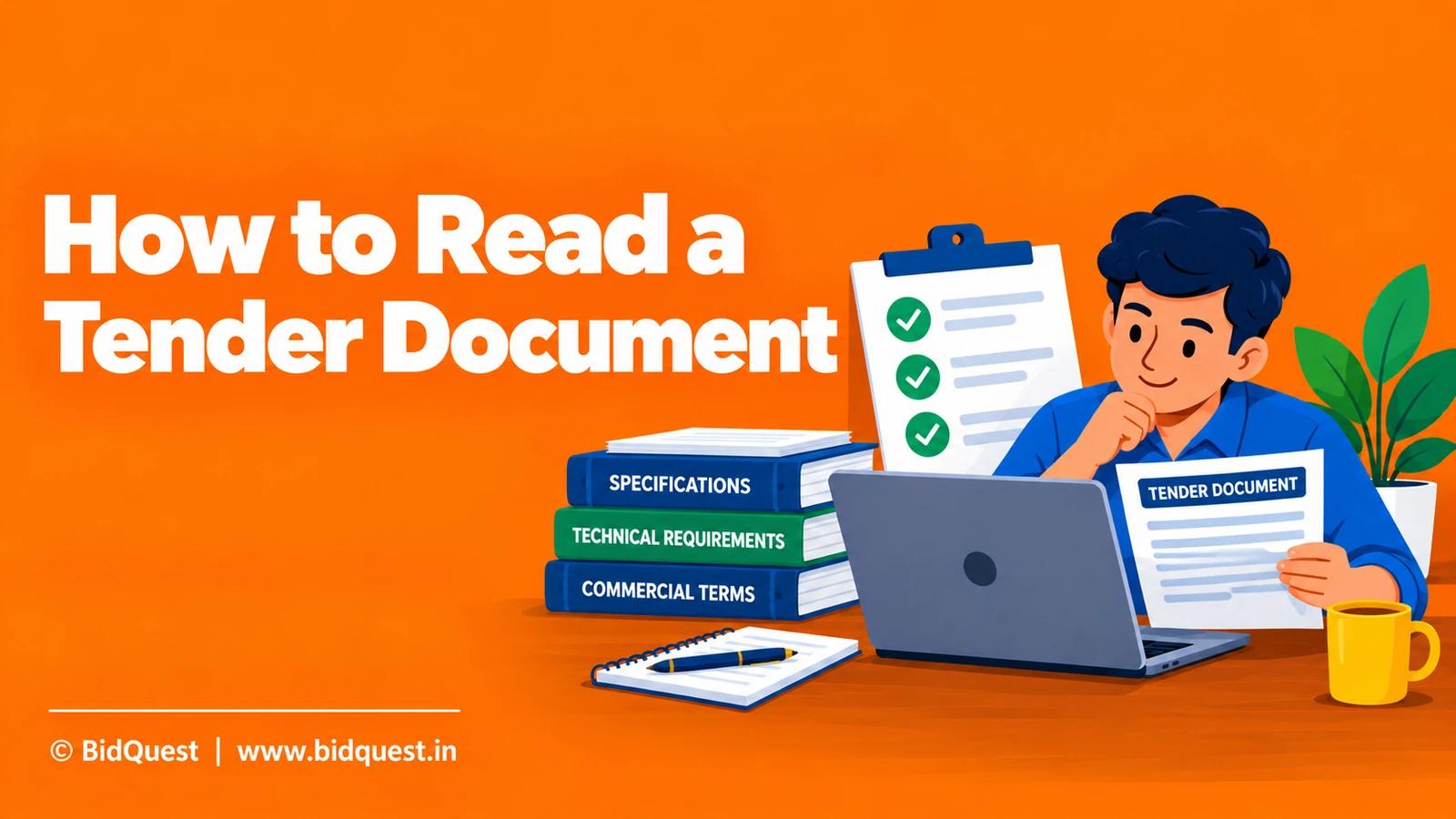
Learn how to read government tender documents in India: NIT, eligibility, technical specifications, BOQ, EMD, evaluation, corrigenda and submission checklist.
Read the guide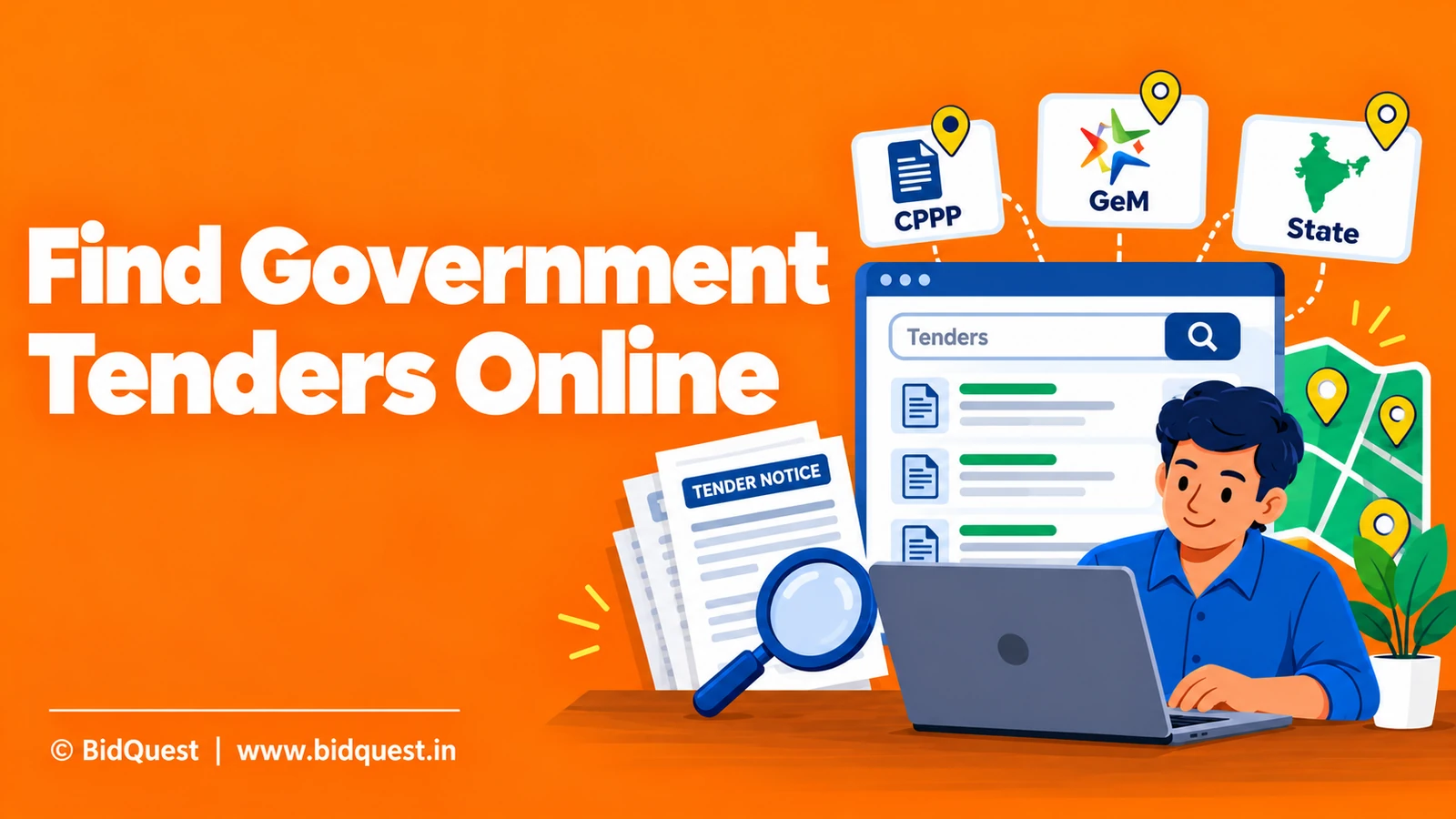
Learn how Indian MSMEs and contractors can find government tenders on CPPP, GeM and state portals, shortlist relevant notices and track corrigenda.
Read the guide
Some procurement provisions reserve specified items for relevant MSE sourcing, but the actual current list, product description and applicable buyer framework must support the claim.
Read the guide