SYSTEM // LOADING
BIDQUEST // 2026
GRID // 1280px
BIDQUEST // 2026
Zero manual search • 100% Free
Prepare a clear GeM issue record with a timeline, contractual references, evidence and resolution request, while distinguishing support from disputes.

This guide provides an original evidence preparation method. Exact GeM incident categories, response windows, remedies and account consequences must be verified in the current official system and applicable terms; this article does not invent them.
Use official GeM resources and seller training for the current workflow.
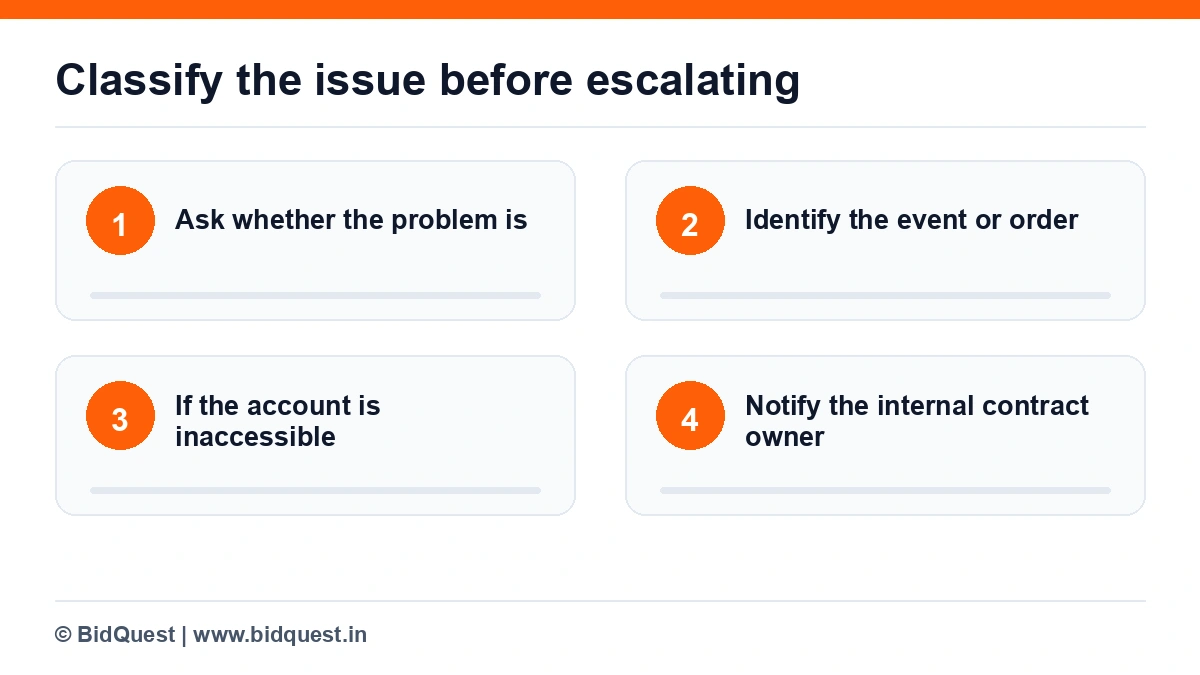
Ask whether the problem is technical access, transaction processing, contractual performance, payment evidence or a formal notice requiring a response.
Identify the event or order involved and the next deadline, where stated. If the account is inaccessible, do not assume that a support ticket automatically suspends an unrelated contractual obligation.
Notify the internal contract owner when performance or a formal response may be affected. Keep the distinction between asking for technical assistance and responding to a procurement decision.
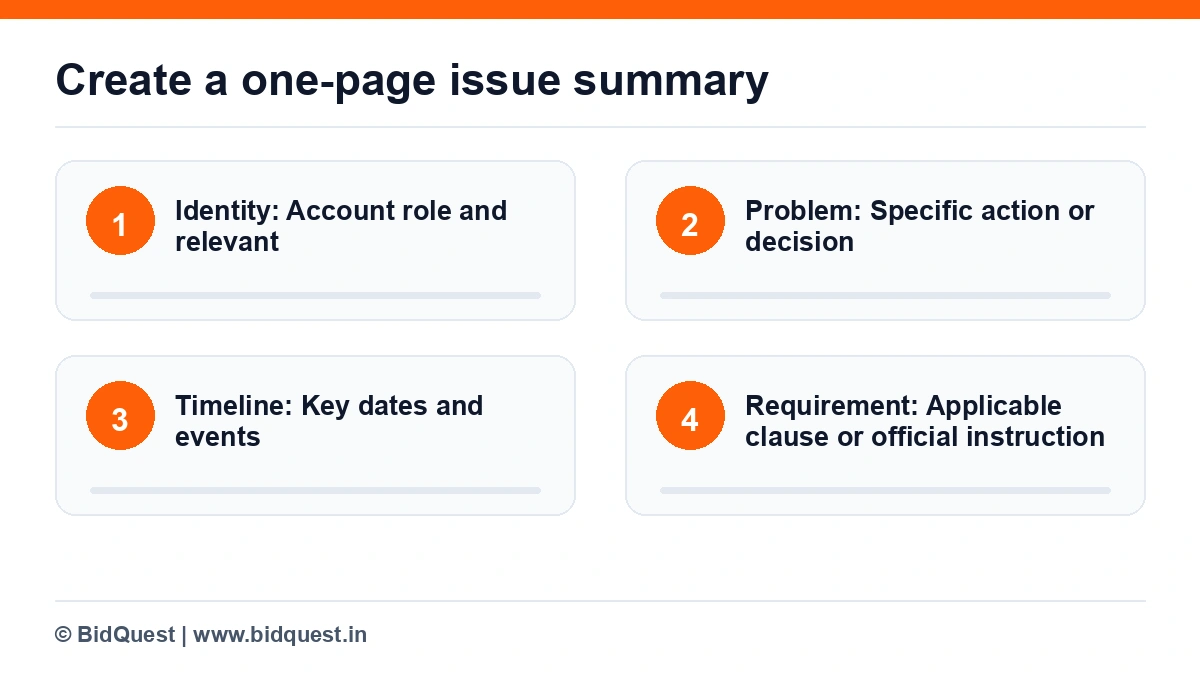
| Field | What to include |
|---|---|
| Identity | Account role and relevant order/event reference |
| Problem | Specific action or decision being questioned |
| Timeline | Key dates and events in sequence |
| Requirement | Applicable clause or official instruction |
| Evidence | Labelled records supporting each fact |
| Impact | Action, delivery or payment affected |
| Request | Specific help or resolution sought |
Give the file a version and owner. If the facts change, update it rather than allowing several team members to send inconsistent accounts.
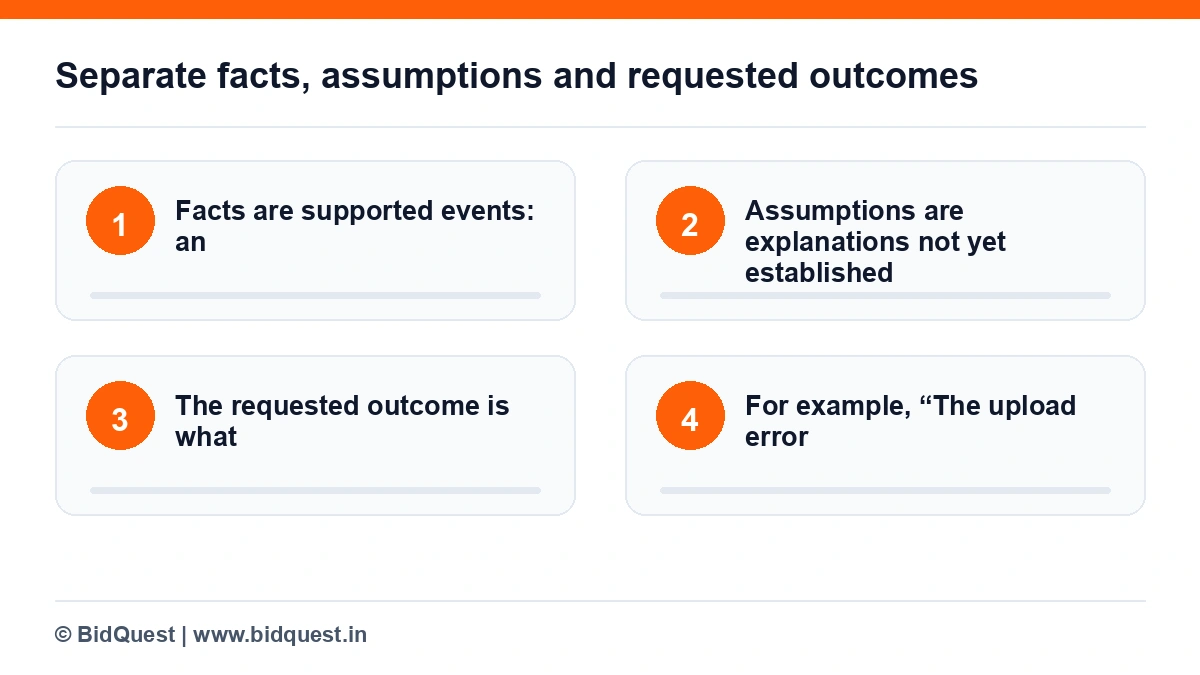
Facts are supported events: an error appeared, a message was received, a document was submitted or a delivery took place. Assumptions are explanations not yet established. The requested outcome is what you want the relevant authority to do.
For example, “The upload error appeared at 11:20 and reference X was created” is a fact if recorded. “The entire platform was down” needs wider evidence and should not be asserted from one workstation failure.
This distinction helps the official reviewer understand the issue without first correcting overstatements.
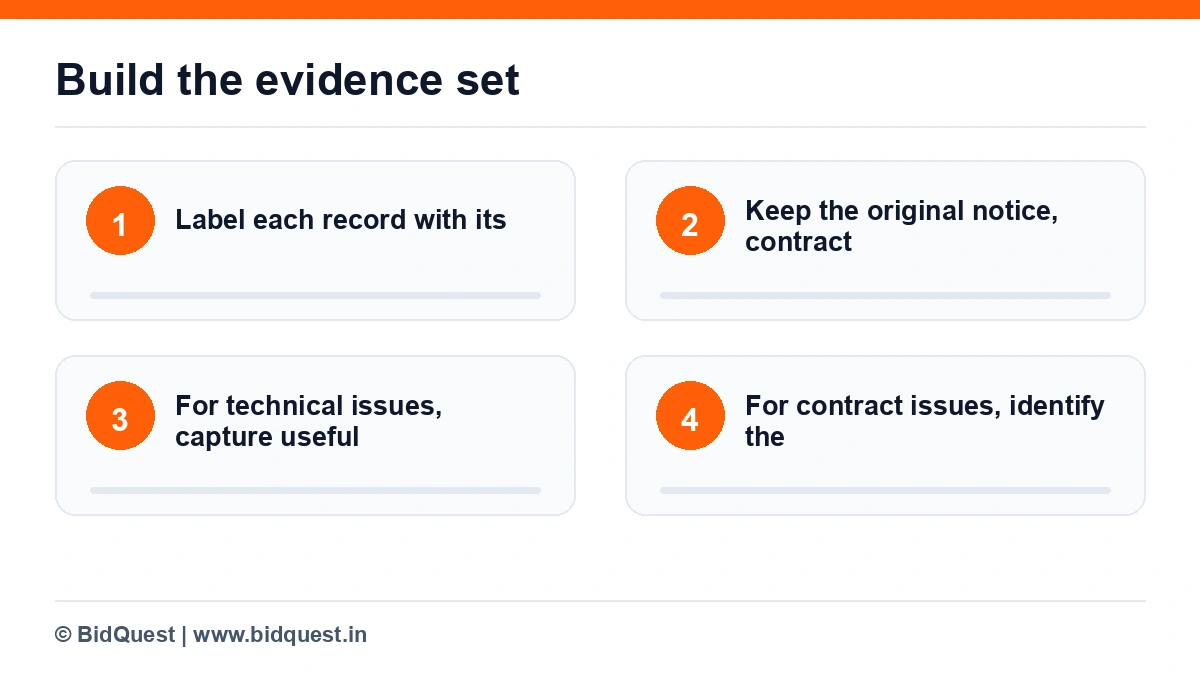
Label each record with its date, source and relevance. Keep the original notice, contract, communications and supporting operational records.
For technical issues, capture useful error information while protecting credentials, OTPs and personal information. For contract issues, identify the clause and performance record rather than attaching a screenshot of the title alone.
Avoid irrelevant bulk uploads. A five-document labelled pack may communicate better than an archive with dozens of duplicates.
A buyer communication alleges that service began late. The supplier's team has attendance records and an email showing the site contact requested a later access date.
The issue owner places the original commencement clause, access request, attendance and notification history into a timeline. It distinguishes the original obligation from the later request and asks for the applicable formal determination.
The team does not claim the email automatically changed the contract. It requests review of the documented facts through the appropriate process and obtains advice if liability is material.
This is a stronger response than a general statement that the buyer caused the delay.
When a formal notice is received, identify its deadline and who is authorised to respond. Give legal, commercial and operational reviewers enough time to examine consequential points.
Do not submit contradictory responses from several employees. Use one approved factual account and preserve the submitted version and acknowledgement.
If documents are missing, record what has been requested and assess the response obligation with the appropriate reviewer. Do not assume an unanswered internal email extends an official deadline.
Keep reference number, last action, current status, next required action and owner. A reminder should ask about the identified pending step, not merely repeat “resolve urgently.”
Where support requests additional information, reconcile it with the evidence pack and provide it through the prescribed route. Avoid sharing secrets or unrelated records as a shortcut.
If the matter changes from technical support to a contractual dispute, reassess ownership and specialist review needs.
Retain the decision or resolution and record any conditions, corrective actions or unresolved points. Confirm practical completion with operations or finance.
A resolved login problem does not by itself resolve a delayed invoice. A correspondence marked closed internally does not prove the official dispute outcome.
Use precise closure categories so management can see whether assistance, contract correction, payment reconciliation or another action was completed.
After closure, identify what the business can improve: clearer handover, better records, earlier notification or a more reliable account process.
Do not rewrite the historical timeline to make the team look better. The value of the record is that future reviewers can understand what actually happened.
Technical access may need the account administrator. A contract-performance issue may need the project owner. A billing mismatch may need finance. A formal adverse notice may require management and specialist review.
Define those routes internally before an incident occurs. One coordinator can keep the file consistent while the competent person handles the substance.
Do not send every problem to whoever last logged into the account. Ownership should reflect the decision and evidence needed.
The issue register should show both the official reference and the internal responsible role so the next action remains clear during a handover.
Number the important facts in the chronology and link each one to a document or record. Use dates, order references and clause citations where available.
If a fact is based on recollection rather than a record, label that limitation. Avoid presenting an internal narrative as though every event was independently verified.
Keep duplicates out of the main index while preserving originals appropriately. A reviewer should find the supporting evidence quickly.
This is especially useful when several employees supplied pieces of the history and their descriptions differ.
For an access or operation problem, identify the attempted action, relevant event, time, non-secret error details and supported troubleshooting already performed.
Avoid a claim that the whole system failed unless you have evidence. A device issue, account permission and platform problem can look similar to the user but require different investigation.
Do not include passwords, private signing information or unrelated personal records. Use verified channels and the official request format where provided.
Tell the bid or contract owner if the issue affects a deadline. Filing support evidence is useful, but its contractual effect requires separate review.
For a performance allegation, identify the obligation, alleged failure, supplied evidence, disputed point and requested determination. Include the actual notice and response deadline.
Have operations verify the timeline and the contract reviewer examine consequential wording. Finance should confirm any proposed amount or billing effect.
Do not casually admit a broad legal liability or assert complete immunity without review. A factual acknowledgement of an event and a legal conclusion about its consequences are different statements.
Keep the authorised response as a fixed submitted version, with its acknowledgement and subsequent decisions.
Consider whether work continues, a delivery is blocked, an invoice is unresolved or account access affects another task. Assign lawful and contract-consistent mitigation to each impact.
For a hypothetical billing issue involving ₹2 lakh, finance may need to remove that receipt from the immediate base forecast until its supporting step is resolved. That does not mean the amount is permanently lost.
Use a separate uncertainty view rather than marking every disputed receipt as certain or zero. Management needs a realistic range and the next evidence-producing action.
Avoid taking unrelated contract actions simply because the issue is frustrating.
When the official process asks for more evidence, record the exact request, owner and due date. Confirm that the reply answers the request rather than resending the original pack unchanged.
If a document is unavailable, explain the position accurately and obtain the appropriate review. Do not create a replacement record that misstates what happened.
Protect sensitive information through the prescribed route. A request for one transaction reference is not necessarily a request for every bank record.
Preserve both the request and response so the chronology remains complete.
A team can finish its response while the official matter remains pending. Use a status such as response submitted rather than resolved.
When a decision arrives, identify what it covers and whether further action is required. A partial resolution should not close unrelated operational or financial tasks.
Ask the competent owner to confirm practical completion. Finance confirms reconciliation; operations confirms corrective work; the account administrator confirms access, as relevant.
Keep the final record understandable without requiring the original participants to explain it.
After closure, compare what the business controlled with what it could only observe or request. Improve evidence, notifications, handover and resource planning where those were weak.
Do not create a confident account of another party's motives from an unexplained decision. Use the official record and distinguish remaining uncertainty.
The most useful lesson is often specific: a required report was missed, an approval was undocumented or the team did not identify the correct support route early.
Turn that lesson into a manageable operating change for the next event.
If responsibility changes while an issue remains pending, transfer the chronology, official reference, submitted response and next deadline. Identify what has been established and what is disputed. Do not require the new owner to guess the status from a long chat history or treat a completed internal response as an official resolution.
Review whether an open issue also affects another order or deadline. Assign those effects separately so solving one support problem does not conceal a remaining contract action.
No. Check the current official route for the specific problem.
Do not assume so. Review contractual obligations and any formal decision separately.
Protect secrets and use verified channels; provide relevant non-secret evidence.
Use a coordinated, authorised response to avoid inconsistent accounts.
No. Those require current official verification and the actual notice or event.
Create a versioned issue summary and evidence index before the next follow-up. Explore BidQuest for discovery, while keeping GeM issue resolution with the official platform and contractual process.
Government e-Marketplace. Accessed 12 Oct 2026.
Government e-Marketplace. Accessed 12 Oct 2026.

Prepare a GeM seller registration information checklist covering account ownership, business profile, tax details, authorised signatory and catalogue readiness.
Read the guide
Learn how to compare GeM buyer-added terms, standard platform terms and bid attachments before pricing or submitting an offer.
Read the guide
Cancellation after acceptance depends on the actual order, applicable GeM terms, authority and reason.
Read the guide