SYSTEM // LOADING
BIDQUEST // 2026
GRID // 1280px
BIDQUEST // 2026
Zero manual search • 100% Free
Prepare a GeM seller registration information checklist covering account ownership, business profile, tax details, authorised signatory and catalogue readiness.
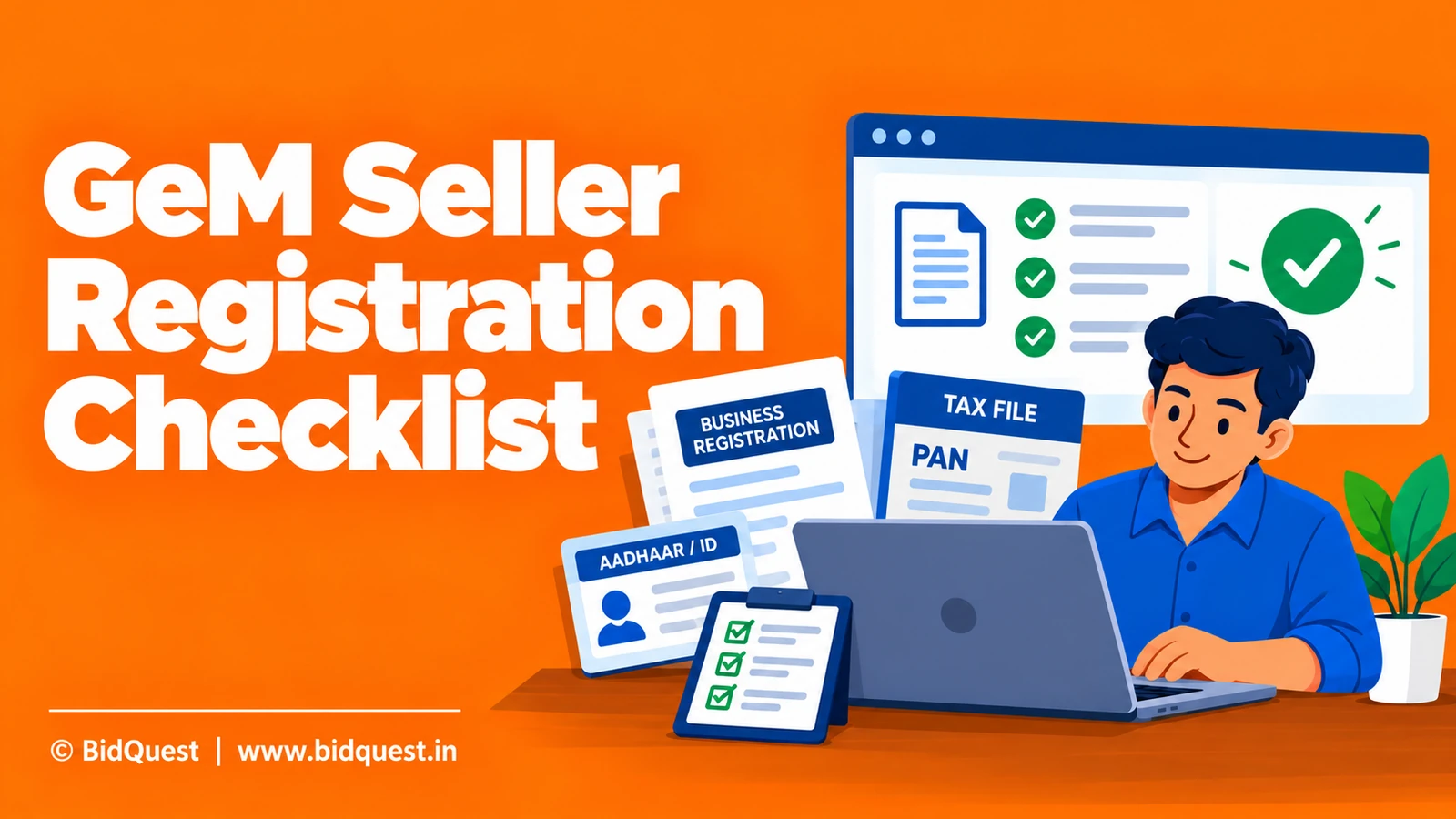
This practical guide is written for new gem sellers and msme administrators. It explains the decision points and checks that matter during procurement rather than relying on old portal screenshots or generic promises. The issuing authority’s current tender documents, formal amendments and official portal instructions take precedence over this article.
Government tender procedures vary with the buyer, procurement category and contract. Use the process below as a working framework, and replace every illustrative assumption with evidence from the specific notice you intend to act on.
For this task, the core question is: Checklist: prepare for GeM seller registration. The answer depends on separating opportunity discovery, formal eligibility, preparation and actual submission. Keep a dated tender folder with the original NIT, conditions, published corrigenda and any supporting evidence. If a buyer has a different instruction, the tender takes priority.
A useful control is to write down who owns each decision. The commercial team can estimate price, but an authorised signatory must verify the bid declarations; a technical specialist can confirm specifications but should not silently interpret policy exemptions. Asking each owner to sign off on the requirements they control is more reliable than a single unchecked document folder.
Use the official GeM portal and seller-learning resources rather than a consultant’s screenshot. The GeM registration guide describes an initial sequence of creating a seller user ID, completing the business profile and adding products or services. Treat these as phases, not as a promise that every business sees identical screens.
Have a single responsible employee maintain a document and data checklist. Confirm who can legally represent the company and who will manage the seller account afterward.
What to record: Add the relevant tender clause or official manual section, the supporting evidence, the person checking it, the last checked date, and an unresolved-issue flag. A document can appear complete while its conditions or validity period still fail the tender; that is why the review log should capture both possession and applicability.
Check that the business name, constitution, operating address and contact details are accurate and consistent in your records. A sole proprietorship, partnership, company and other business forms may use different supporting data. Do not invent a compulsory list for every seller type.
Use names exactly as recorded in the underlying legal and registration documents where the portal requires them. Resolve differences before entering repeated information into multiple fields.
Common failure to avoid: Do not copy an assumption from a different tender. Verify the current notice and its amendments, keep the original source link, and ask for formal clarification before the buyer’s query cutoff if a consequential instruction is unclear.

The primary user should have authority to act for the business and access to the contact channels used for verification. Keep personal and business account access separate where required. Never share one-time passwords or hand over permanent account access casually to a third party.
Document who owns the account, who performs catalogue updates, and who can respond to buyer communications. Plan handover procedures if an employee changes roles.
Team hand-off: Explain the decision to the next owner in plain language. Include the exact file or clause and what still requires approval. An unexplained “done” status offers little protection when a colleague must assemble the final response.
Organise the tax registration, banking and enterprise-classification information that applies to your business. Whether a particular field or supporting document is mandatory may depend on seller type and current GeM configuration. Use the actual portal prompts as the definitive checklist.
Verify that legal names and account identifiers agree. Do not publish tax IDs, bank records or passwords in shared spreadsheets that are wider than the onboarding team.
What to record: Add the relevant tender clause or official manual section, the supporting evidence, the person checking it, the last checked date, and an unresolved-issue flag. A document can appear complete while its conditions or validity period still fail the tender; that is why the review log should capture both possession and applicability.

Registration is not the same as catalogue publication. Decide the products or services you can actually supply, their specifications, delivery footprint, service capabilities and available documentation. GeM seller courses separately cover catalogue management, bid participation and order fulfilment.
Avoid listing goods for which you cannot substantiate required specifications or authorisations. A complete, accurate catalogue is more useful than many vague descriptions.
Common failure to avoid: Do not copy an assumption from a different tender. Verify the current notice and its amendments, keep the original source link, and ask for formal clarification before the buyer’s query cutoff if a consequential instruction is unclear.
The existing BidQuest GeM registration fees guide explains that official seller registration is free according to the published GeM seller guidance, while an optional private consultant may charge for services. Keep any consultancy invoice separate from official platform requirements.
If a third party requests money or account credentials, verify what service is being purchased and whether it is necessary. Never assume payment guarantees registration success or orders.
Team hand-off: Explain the decision to the next owner in plain language. Include the exact file or clause and what still requires approval. An unexplained “done” status offers little protection when a colleague must assemble the final response.

After access is established, review profile accuracy, product descriptions, buyer messages and changes to official seller policies. Train a backup employee in safe account governance without giving uncontrolled credential access.
The goal is a durable selling workflow: validated seller information, a truthful catalogue and disciplined handling of bid and order requirements.
What to record: Add the relevant tender clause or official manual section, the supporting evidence, the person checking it, the last checked date, and an unresolved-issue flag. A document can appear complete while its conditions or validity period still fail the tender; that is why the review log should capture both possession and applicability.

A hypothetical furniture manufacturer plans to register on GeM. Before opening the portal, its administrator identifies the authorised user, checks the company’s registered name against supporting records, prepares applicable business and tax information, and lists the furniture categories it can actually manufacture. A catalogue manager later checks dimensions, materials and delivery commitments before listing products. This reduces corrections without assuming specific GeM fields.
The lesson from this scenario is to make each decision reproducible. Another colleague should be able to locate the original notice, understand why a requirement was treated as applicable or not applicable, and confirm which version was used for the submission. Keep records of unresolved questions rather than turning them into facts.
| Review item | What to capture | Evidence to retain |
|---|---|---|
| Official source | Buyer portal and tender reference | Original notice URL and downloaded copy |
| Required action | What the clause instructs | Clause reference and annexure |
| Assigned owner | Who verifies and signs off | Dated checklist entry |
| Change monitoring | Any new corrigendum or portal notice | Amendment register |
| Submission proof | Official completion or acknowledgement | Portal-generated record, if relevant |
This table is a practical control rather than an additional government requirement. Adapt it to the actual procurement form and do not substitute an internal spreadsheet for official portal confirmation.
BidQuest is a SaaS service, not a government tender-issuing or bid-submission authority. You can use the existing BidQuest tender search as another place to research relevant opportunities before opening the corresponding official notice. This distinction is especially important where eligibility, money, bid security, deadlines or award outcomes are concerned. BidQuest cannot change the buyer’s conditions, confer exemptions, or guarantee results.
After discovery, confirm the original tender on CPPP, GeM or the designated state/buyer portal. Use that official channel for required registration, clarification, uploads, payments and acknowledgements. The practical value of brand integration is helping readers move from useful guidance to an appropriate next action, not replacing the government workflow.
No universal list is asserted here. Use the current portal requirements for your constitution, categories and verification flow.
A consultant may offer optional assistance; follow the official GeM registration guide and separate any private service fee from official portal requirements.
No. Each relevant transaction or bid has its own participation and performance requirements.
For current primary documentation, use: GeM Seller Registration Guide; GeM Seller Journey Courses; Government e-Marketplace. Source access reviewed 9 October 2026; the source pack records which sections support each general claim and which live event conditions remain unverified.
Next step: Review the particular tender with the checklist above, then explore relevant opportunities on BidQuest and return to the government portal for the authoritative documents and actions.
Government e-Marketplace. Accessed 9 Oct 2026.
Government e-Marketplace. Accessed 9 Oct 2026.
Government e-Marketplace. Accessed 9 Oct 2026.
Learn how to separate official GeM registration costs, other platform obligations, and optional consultant charges before paying for assistance.
Read the guide
Learn how Indian MSMEs and contractors can find government tenders on CPPP, GeM and state portals, shortlist relevant notices and track corrigenda.
Read the guide
Cancellation after acceptance depends on the actual order, applicable GeM terms, authority and reason.
Read the guide