SYSTEM // LOADING
BIDQUEST // 2026
GRID // 1280px
BIDQUEST // 2026
Zero manual search • 100% Free
Learn how to compare GeM buyer-added terms, standard platform terms and bid attachments before pricing or submitting an offer.
This guide is written for Indian suppliers, contractors, MSMEs and bid teams who need a repeatable decision process, not a shortcut around the buyer's rules. The issuing department's live notice, attachments, amendments and portal instructions control every submission. A general procurement manual explains a framework; it does not replace a particular tender. The examples below are hypothetical training examples, not quotations from real government bids.
The main question is GeM ATC vs GTC. The answer depends on the exact procurement type, buyer, category, and tender wording. Keep a copy of the original tender with its version and publication date, note the clause number beside every decision, and ask the buyer through the permitted clarification channel where a requirement is unclear. Do not infer eligibility, price preference, contract award, or portal acceptance from this guide alone.
A seller often opens a bid summary, reads the product name and deadline, and starts calculating a price. That skips the clauses that may determine whether the contract is workable. Download or preserve the official bid notice, product or service specification, buyer-uploaded ATC documents, applicable GeM terms and subsequent corrigenda. Create an index showing the file name, date, version and purpose. The GeM Seller Journey includes a Bid and RA Participation course, but the live bid and portal terms remain the authority. Never rely on an old screenshot of a clause when a current version is available in the seller account.
General Terms and Conditions provide platform-wide contractual context, while buyer-added conditions express requirements for the particular purchase. They may concern inspection, installation, site readiness, documentation, warranty, delivery location or service levels. The seller must not invent a hierarchy of documents. If a buyer-added clause appears inconsistent with the platform's rules or another part of the bid, record the exact wording and request an official clarification. It is risky to treat a questionable clause as harmless because someone in a messaging group says it will not be enforced. Keep a written resolution or a defensible no-bid decision.

Look beyond the unit price. A clause requiring delivery to several locations can multiply freight and unloading costs. On-site installation may need travel, technicians and consumables. Inspection before acceptance may delay invoicing. A warranty obligation may require spare inventory or a response partner in another city. Some terms may require performance security or specify deductions for late performance. Build a cost sheet with one row per obligation and a named estimator. Mark every assumption explicitly. A tender that looks profitable from the headline quantity may be loss-making after logistics, service and payment timing are included.
An ATC attachment may refer to standards, certificates, compatibility requirements or demonstration procedures not visible in the short product title. Map each item to evidence: datasheet page, test report, manufacturer declaration or service plan. Avoid answering "yes" to a specification that is only partially met. If the buyer's requirements use ambiguous language such as "equivalent" or "latest", seek clarification before relying on an interpretation. The goods procurement manual's sections on specifications and tender documents offer background, but buyer-specific acceptance criteria must be read in their actual context.
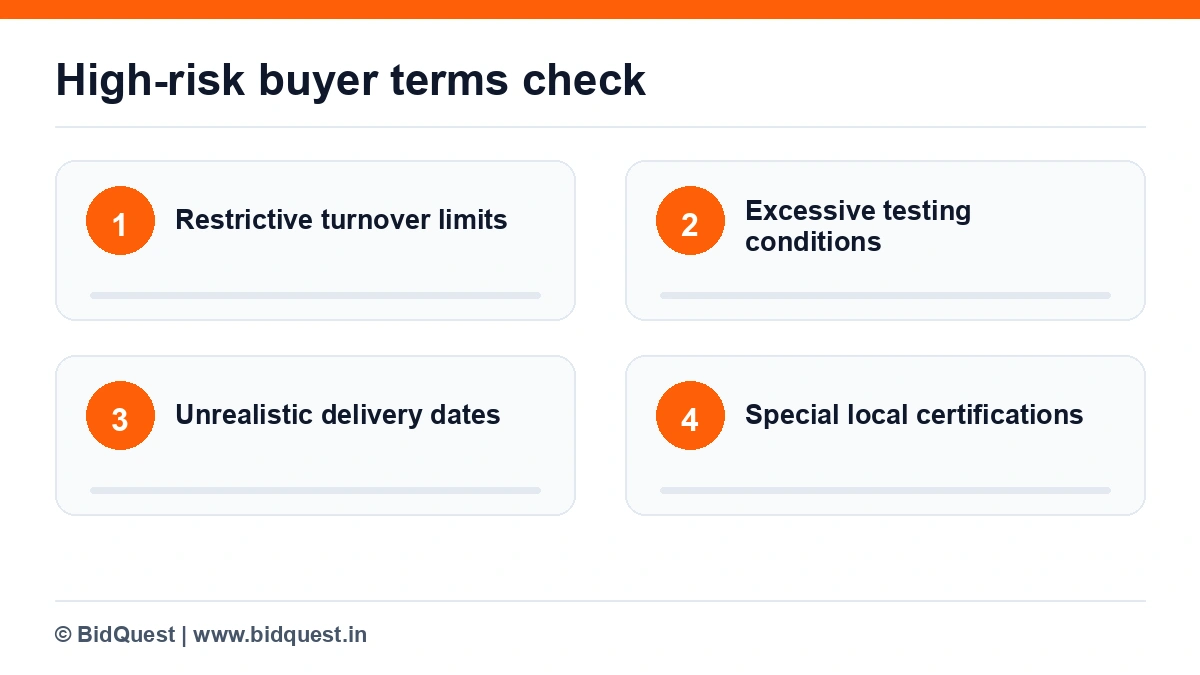
The submission deadline is only one date. A bid may also have a pre-bid question cutoff, inspection or demonstration schedule, delivery deadline, warranty start trigger, security submission deadline and invoice documentation requirements. Put each in a dated obligations calendar. Ask who is responsible for each action and what evidence will prove completion. When a corrigendum changes the bid deadline, do not assume it changes every downstream milestone. Recalculate lead time using the latest formal schedule. The cost of an overlooked early inspection or site readiness condition can be larger than the margin on a small supply order.
Identify who bears transit loss, unloading damage, failed inspection, delayed access to the site, defective goods and replacement transport. Distinguish contractual penalties or liquidated damages from ordinary warranty obligations. Do not assume every standard deduction applies to every bid; read the trigger, base and cap. Note any dispute-resolution or notice requirements. For a complex service contract, involve operations and finance in the review. A simple red-amber-green matrix can help: red for impossible requirements, amber for unresolved cost or interpretation, green for evidenced compliance. Price only after red items are resolved or the business has consciously declined the opportunity.

If an ATC appears to demand something inconsistent with platform rules, preserve the exact clause, relevant standard term and any official guidance. Do not silently delete the clause from your response or attach an unauthorised alternative. Use the buyer's official query mechanism and, where appropriate, GeM's prescribed support or grievance route. Keep correspondence professional and specific: state the clause, explain the conflict and ask which condition governs. If the clarification is not received before the deadline, record the uncertainty in the bid/no-bid decision. A verbal reassurance from an intermediary is not a contract amendment.
After an award, the delivery team should receive the same ATC matrix that sales used for pricing. Include the latest official bid version, accepted offer, award documents and any authorised amendments. This prevents a common handover failure in which sales promises an on-site warranty but operations plans only depot service. Track inspection records, notices and buyer acknowledgements against the clause numbers. A disciplined handover also makes invoice preparation easier because finance knows which acceptance documents are needed. The purpose of reviewing ATCs is not merely to avoid disqualification; it is to deliver what the seller actually agreed to supply.

A hypothetical office-equipment bid requests 80 printers. The price schedule appears simple, but the buyer ATC requires installation at eight district offices, operator training and a two-day response window during warranty. The seller's original quote covers delivery to one warehouse only. Its internal cost model adds eight site visits at ₹4,000 each (₹32,000), training materials of ₹8,000 and a service reserve of ₹20,000, before tax treatment. The team then checks whether the buyer's contract and GeM terms allow the intended service arrangement. If the seller cannot meet the response time, raising the price does not cure the technical gap. The correct decision is to obtain a compliant service partner or decline the bid.
| Review point | Evidence to inspect | Practical decision |
|---|---|---|
| Buyer ATC | Official bid attachment and latest corrigendum | Extract every added obligation |
| Standard terms | Current applicable GeM GTC | Flag possible conflicts |
| Technical evidence | Datasheets, certificates and service plan | Mark each clause evidenced or unresolved |
| Price exposure | Logistics, installation, warranty worksheet | Cost all obligations |
| Contract handover | Accepted offer and award package | Transfer obligations to operations |
A table is a decision aid, not a substitute for the actual document. Write the tender reference, clause and amendment date against every row in your working copy. If a requirement cannot be verified, mark it unresolved and assign an owner; do not quietly treat it as satisfied.
Treat the checklist as a living record. Assign each line to one person, attach the source file, and record when it was checked. On the final submission day, re-open the official portal to confirm whether a corrigendum, revised schedule, or changed attachment supersedes your saved copy. Keep the submission acknowledgement or contract communication in the tender folder.
The first mistake is confusing a helpful summary with an authoritative instruction. Search results, aggregator cards and internal spreadsheets may omit exceptions or later amendments. The second is assuming that a rule applicable to central government goods procurement applies identically to works, services, state tenders and GeM bids. The third is allowing the commercial team to quote before the technical owner has confirmed scope and acceptance criteria. The fourth is treating an unsigned internal note as evidence that a buyer accepted a deviation. The prevention is straightforward: cite the live tender clause, preserve the original file, and use written official clarification when necessary.
BidQuest is a private SaaS tender-discovery and review aid, not GeM, CPPP, a state e-procurement portal, or a government authority. Its public website describes tender search and matching features. You can use BidQuest to explore potentially relevant opportunities and then carry out the checks in this article against the buyer's original documents. BidQuest does not issue eligibility certificates, grant exemptions, approve bid documents, submit an official bid for you, or guarantee a tender award. For a useful starting point, see our published guides to finding government tenders and reading tender documents.
Optional next step: Explore tender opportunities on BidQuest, then verify the original notice on the official procurement portal.
Do not assume a universal hierarchy. Check the current GeM rules and resolve the specific conflict through official channels.
No. Seek clarification or choose not to bid if it cannot be accepted.
Model every warranty or service obligation the seller is accepting, in the format required by the bid.
GeM provides Seller Journey courses including Bid and RA Participation.
The following primary sources were checked on 11 October 2026. The named section or course identifies where to verify the relevant principle. Always check later amendments and the live tender.
Editorial status: draft, not approved for publication. Technical and legal conclusions must be checked against the applicable tender and current government instructions before release.
Government e-Marketplace. Accessed 11 Oct 2026.
Department of Expenditure. Accessed 11 Oct 2026.
Learn how to separate official GeM registration costs, other platform obligations, and optional consultant charges before paying for assistance.
Read the guide
Learn how to read government tender documents in India: NIT, eligibility, technical specifications, BOQ, EMD, evaluation, corrigenda and submission checklist.
Read the guide
Cancellation after acceptance depends on the actual order, applicable GeM terms, authority and reason.
Read the guide