SYSTEM // LOADING
BIDQUEST // 2026
GRID // 1280px
BIDQUEST // 2026
Zero manual search • 100% Free
Review GeM seller catalogue, bid commitments, delivery capacity, acceptance evidence and service obligations before pricing or fulfilling orders.
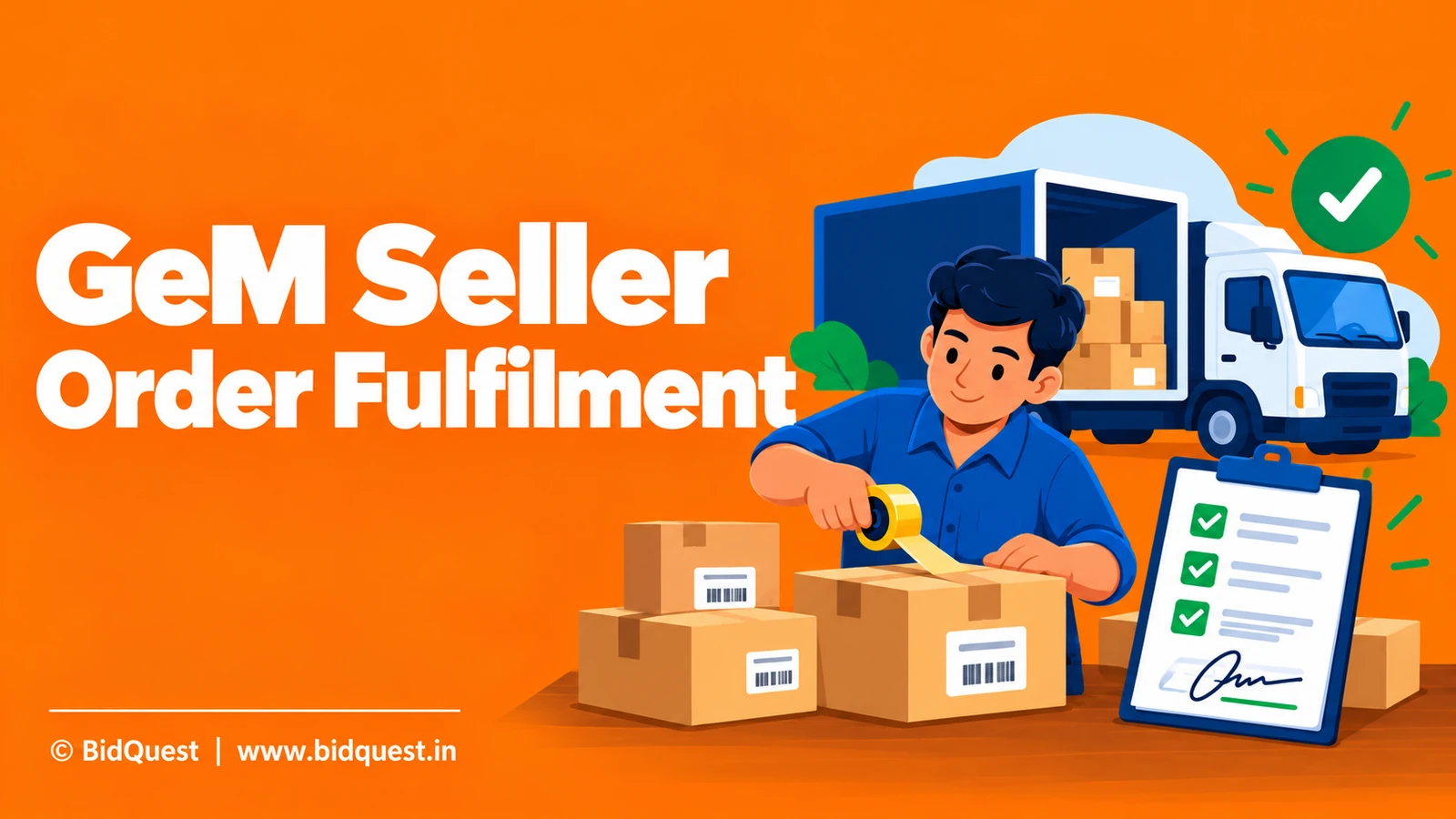
This guide is educational and uses the official tender and its latest corrigenda as the final source for a live procurement. Rules differ by buyer, category and procurement date. The examples below are fictional and are not advice that a particular enterprise qualifies or will win. The official references were accessed on 10 October 2026.
Start by saving the original notice, all referenced annexures and the latest amendment. Give the bid one stable internal ID so that the technical, commercial and authorised-signatory teams work from the same document version. A source-backed note should state not just what the team believes, but which clause supports that belief and who checked it. If a mandatory requirement remains unclear, use the buyer’s formal clarification process before the permitted cutoff.
A seller who has created an account may still need catalogue work, bid-specific evidence or operational capacity. The GeM Seller Journey learning page lists six courses, including Registration & Account Management, Catalogue Management, Bid and RA Participation, and Order Fulfillment. Use those official learning resources to locate the current workflow, then inspect your actual seller account for instructions. Training modules explain categories of tasks but do not replace an individual order’s conditions.
Evidence to retain: Write a stage-specific checklist: account status, catalogue status, bid readiness, order readiness and payment evidence. Keep the official training link and account prompts used for verification.
Failure to avoid: Do not interpret a successful registration as proof that every category, bid or order can be served without additional requirements.

A catalogue description should reflect the product or service that will actually be supplied. Compare model, brand, technical attributes, unit, packaging, warranty and any buyer-specific requirements. For services, compare activity schedules, personnel qualifications and locations. If a requirement is ambiguous, use the authorised clarification route instead of promising a capability you cannot document. An inaccurate listing can create a commercial problem long before the delivery date.
Evidence to retain: Keep a product or service evidence sheet with datasheet version, available stock or staffing, responsible reviewer and any deviation requiring clarification.
Failure to avoid: Do not use attractive generic marketing language to cover a material difference in specification. The buyer will evaluate the contracted requirement, not a sales brochure.
A competitive bid can become a loss if freight, installation, commissioning, consumables, site visits, warranty support or service staffing are omitted. The Department of Expenditure Non-Consultancy Services Manual discusses activities schedules and personnel requirements, including shifts and relievers, as a useful framework for service cost review. Actual GeM order terms and category-specific rules control what is payable. Build a cost sheet that separates included scope from clearly permitted extras.
Evidence to retain: Have finance approve direct cost, tax treatment, logistics, warranty reserve, payment timing and financing. Keep vendor quotations current.
Failure to avoid: Do not assume that an unstated charge can be added after award or that a buyer will accept a unilateral scope exclusion.

Read the delivery schedule, consignee locations, installation obligations, inspection process, acceptance evidence and remedies for delay. A seller may have stock but still fail because delivery to multiple locations or acceptance testing was not planned. For service orders, map shifts, reporting, performance measures and escalation contacts. Build a calendar backward from each milestone with time for dispatch, transport and issue resolution.
Evidence to retain: Capture the order reference, milestone, consignee, evidence required, owner and contingency. Confirm who signs delivery and acceptance documents.
Failure to avoid: Do not treat dispatch as identical to completed contractual delivery when the order requires installation, commissioning or acceptance.
The Non-Consultancy Services Manual discusses performance standards and SLAs in the service planning sections and LD in §§9.4.6–9.4.9. Those passages provide a useful checklist of questions, not universal GeM penalties. Read the applicable GeM category and order terms to identify actual deductions, response times, cure periods and reporting obligations. The right commercial decision may be to decline a bid that requires service coverage your team cannot sustain.
Evidence to retain: Create a risk register with obligation, measurement, evidence, potential remedy, operational owner and escalation route. Review any high-impact term with qualified advisers.
Failure to avoid: Never quote a manual’s illustrative percentage as the automatic penalty for every GeM transaction.

Good fulfilment records make disputes easier to resolve. For goods, retain the order, serial or batch details where relevant, dispatch proof, delivery documents, installation records and acceptance communication. For services, retain attendance, service logs, quality reports and authorised approvals according to the contract. Keep personal data limited to what is necessary and protect access. Evidence should be organised by order and date rather than scattered across personal chat threads.
Evidence to retain: Define who creates each record and where it is stored. Review completeness before invoicing and use only official transaction workflows for required submissions.
Failure to avoid: A screenshot of an internal task board is not a substitute for the buyer’s prescribed delivery or acceptance record.
If stock availability, a service location or a deadline changes, inform the appropriate buyer contact through the permitted official process. Do not silently substitute goods or staffing. Document the issue, proposed remedy, approval and updated milestone. Some orders may permit amendments; others may not. The correct approach depends on the contractual terms and current GeM process.
Evidence to retain: Keep a dated exception log: problem, affected obligation, official message reference, authorised decision and new evidence required.
Failure to avoid: An informal phone assurance should not be treated as an amendment to a contractual specification or delivery obligation.
BidQuest is an independent tender-discovery and analysis SaaS, not GeM. It can be a starting point for researching opportunities, but seller registration, catalogue actions, bids, orders, acceptance and payments belong in the relevant official systems. Confirm every material listing against the original buyer or GeM record. Keep product promises modest and verified: this article does not claim that BidQuest can fulfil orders or obtain government approvals for a seller.
Evidence to retain: Maintain an official-source URL next to each discovered opportunity and assign an authorised seller-account owner for transaction steps.
Failure to avoid: Do not share GeM passwords, OTPs or signing credentials with a third-party discovery service.

A fictional office-equipment supplier lists a printer and sees a government bid requiring delivery to five sites plus installation and a three-year service commitment. The unit margin looks attractive until finance adds travel, installation labour, spare parts and service visits. The seller checks the official category terms and buyer specifications, then decides to quote only if a local service partner can meet the documented obligations. This is an example of operational diligence, not a description of a current GeM bid or a guarantee of platform features.
The example is deliberately simplified. In a real bid, replace every assumption with the current notice, the relevant attachment, the applicable portal instructions and an approved cost or eligibility record. If a crucial fact cannot be verified, mark it as unresolved rather than turning it into an apparent rule.
| Review field | What the team should enter | Why it matters |
|---|---|---|
| Official tender | Buyer, ID, original URL and date accessed | Prevents decisions from stale copies |
| Requirement | Exact clause, annexure and version | Makes the decision auditable |
| Evidence | Certificate, quotation, calculation or official response | Separates proof from assumption |
| Accountable owner | Named technical, finance or signatory reviewer | Prevents an unowned gap |
| Decision | Pass, fail, unresolved or next action | Supports a reproducible bid decision |
| Recheck trigger | Corrigendum, deadline, cost or capacity change | Keeps the conclusion current |
The table is an internal management tool, not a government-prescribed form. For consequential legal, labour, financial or exemption questions, have a qualified reviewer assess the current rules and contract. Do not attach an internal score to a government bid as if it were official certification.
Before approving effort or a submission, ask whether the team has checked the latest official version, whether each mandatory condition has a cited answer, whether delivery capacity and financing have been tested, and whether the authorised signatory knows what remains uncertain. Check that the price assumptions match the same scope version as the technical proposal. Record which colleague must act if a new corrigendum appears. A clear “not yet verified” is more useful than a confident but unsupported tick mark.
For small teams, a fifteen-minute review with the notice open can prevent days of rework. One person should read the requirement aloud, another should point to the evidence, and the owner should confirm the commercial consequence. If nobody can locate the supporting clause, keep the issue open. After the decision, store the signed review note beside the actual bid files so a later team member can reconstruct why the bid was pursued or rejected.
BidQuest is an independent tender-discovery and analysis SaaS, not GeM, CPPP, a state eProcurement portal or a government procurement authority. Its public website presents tender discovery as a service. A business may use BidQuest’s verified public homepage as a starting point to explore opportunities, then check the original buyer notice and every formal amendment on the official portal. This article does not claim automatic eligibility, bid submission, fee exemptions, guaranteed wins or verified coverage of every procurement.
The relevant next step is modest: use a discovery tool to locate opportunities worth examining, then make the qualification and submission decision from official records. Keep login credentials, digital-signature private keys and one-time passwords within the authorised government-portal workflow.
No. Catalogue, bid and order-specific conditions still matter.
GeM’s Seller Journey learning page includes catalogue, bid and order-fulfilment courses.
Do not assume so. Follow the applicable official order and amendment process.
No such capability is asserted here; official order fulfilment remains with the seller and GeM process.
These primary sources support the general procedure described above. They do not verify the eligibility, pricing or deadline of any individual live tender. Source sections and the access date are preserved in the accompanying source pack.
GeM Seller Journey Learning Resources (Government e-Marketplace), Seller Journey courses 01 Registration, 02 Catalogue, 03 Bid and RA, 04 Order Fulfillment; accessed 2026-10-10.
Manual for Procurement of Non-Consultancy Services, 2025 (Department of Expenditure), §2 Need Assessment: Activities and Personnel Schedules (printed pp. 35–36); §9.3.3 SLA (printed p. 164); §9.4.6–9.4.9 LD (printed pp. 167–169); accessed 2026-10-10.
Udyam Registration: Important to Know (Ministry of MSME), Registration Process / More on Registration Process; accessed 2026-10-10.
Final check: Reopen the official tender, check all amendments and obtain the required internal approval before acting. This draft is not published and is not a government notice.
Government e-Marketplace. Accessed 10 Oct 2026.
Department of Expenditure. Accessed 10 Oct 2026.
Ministry of MSME. Accessed 10 Oct 2026.
Learn how to separate official GeM registration costs, other platform obligations, and optional consultant charges before paying for assistance.
Read the guide
Learn how to read government tender documents in India: NIT, eligibility, technical specifications, BOQ, EMD, evaluation, corrigenda and submission checklist.
Read the guide
Cancellation after acceptance depends on the actual order, applicable GeM terms, authority and reason.
Read the guide