SYSTEM // LOADING
BIDQUEST // 2026
GRID // 1280px
BIDQUEST // 2026
Zero manual search • 100% Free
Understand when a GeM bid may request OEM authorisation, how resellers can verify scope and validity, and how to avoid unsupported manufacturer claims.
This guide is written for Indian suppliers, contractors, MSMEs and bid teams who need a repeatable decision process, not a shortcut around the buyer's rules. The issuing department's live notice, attachments, amendments and portal instructions control every submission. A general procurement manual explains a framework; it does not replace a particular tender. The examples below are hypothetical training examples, not quotations from real government bids.
The main question is GeM OEM authorisation letter. The answer depends on the exact procurement type, buyer, category, and tender wording. Keep a copy of the original tender with its version and publication date, note the clause number beside every decision, and ask the buyer through the permitted clarification channel where a requirement is unclear. Do not infer eligibility, price preference, contract award, or portal acceptance from this guide alone.
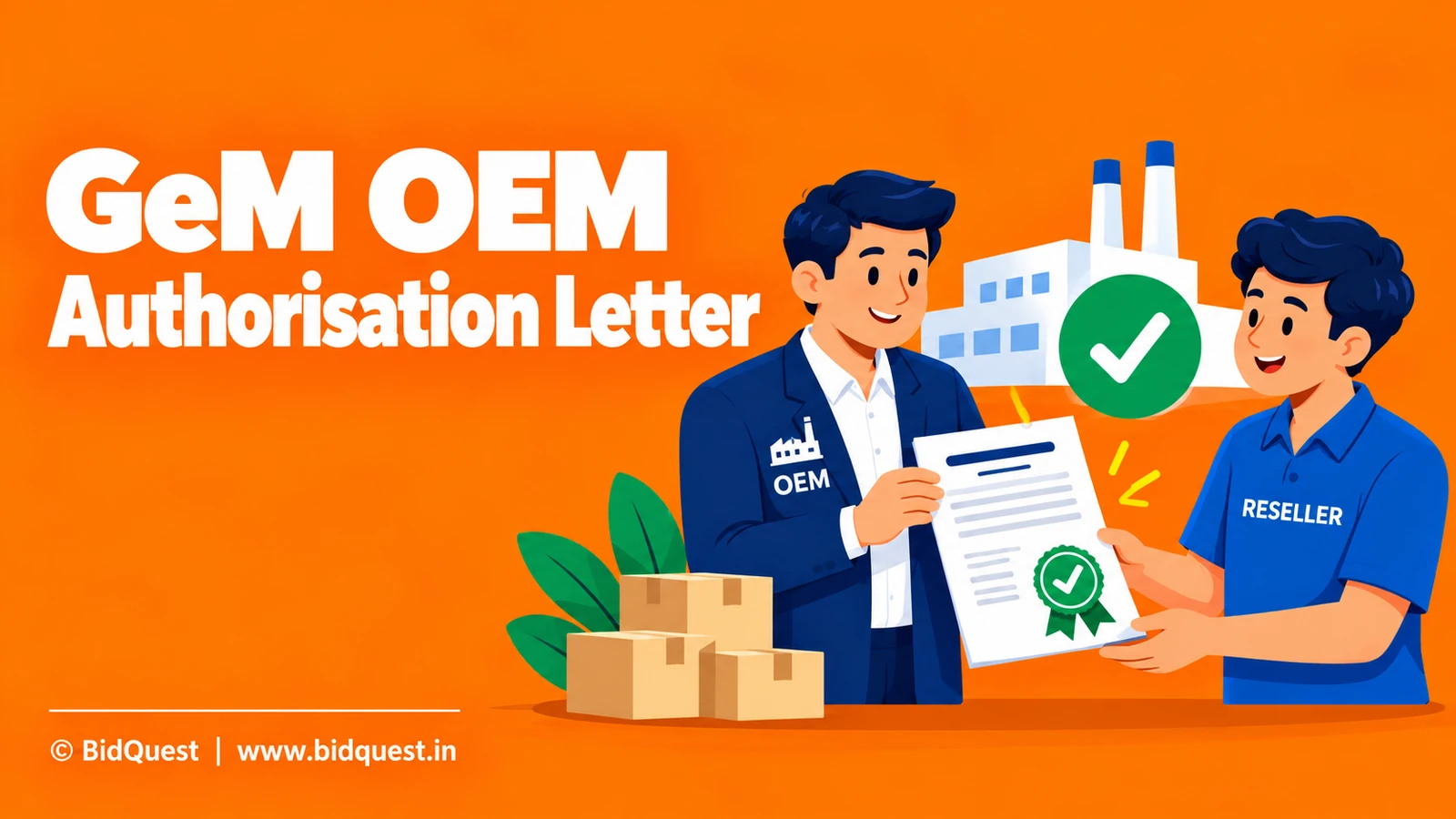
When a buyer asks for OEM authorisation, the practical concern is usually traceability and support: is the seller entitled to supply the genuine item, and can the promised warranty or service be delivered? A manufacturer may appoint a national distributor, a regional dealer or a partner for one product line only. Those relationships are not interchangeable. A reseller should identify whether the buyer wants a manufacturer authorisation form, a distributor chain letter, a bid-specific undertaking, or some combination. The word "authorised" in a marketing brochure is not proof of a right to supply every model. Always read the buyer's uploaded terms, product specifications and any clarifications before requesting a letter from the manufacturer.
The entity named in the letter should match the bidding seller or be supported by an explicitly permitted chain of authority. Check the seller's legal name, trade name, GST details where required, and the issuing manufacturer's full legal name. A letter addressed to a different company may not establish the bidder's rights. If an authorised distributor issues a sub-dealer letter, ask whether the tender permits that form and whether the distributor itself has authority to sub-authorise. Never fabricate a manufacturer letterhead, digital signature or stamp. If the manufacturer will not issue the required evidence, treat it as an eligibility gap and use the official pre-bid clarification channel when appropriate.

A letter may cover one brand, one product family, one geography or one procurement reference. Build a scope table with manufacturer, brand, model, territory, end customer, bid reference and authorised activity. "Marketing" may not mean "selling with manufacturer-backed warranty". A letter authorising supply of printers may not cover cartridges or extended service. Check whether the manufacturer is offering direct support, parts availability or merely permission to resell. Do not enlarge the letter's meaning when preparing the technical response. If the buyer requests an OEM-backed service commitment, obtain that commitment explicitly rather than attaching a generic dealership certificate.
Record the issue date, validity period and any conditions for revocation. A letter that was valid when a product was first listed may be expired by the bid deadline. Compare the signatory's role with the manufacturer's usual authorisation process, and keep a confirmation email from a verified manufacturer domain if feasible. Beware of edited PDF files, mismatched logos and inconsistent product codes. For high-value or sensitive goods, the bid team should escalate doubts to the manufacturer rather than relying on a broker's assurance. The objective is not to create a complicated compliance burden; it is to prevent a false statement that can expose the bidder to rejection or contractual problems.

Even a genuine authorisation letter does not prove the offered item meets every specification. Maintain one matrix for the product and another for business authorisation. A manufacturer may authorise supply of a 3 kVA unit while the buyer requires 5 kVA. The signed letter does not cure that mismatch. Similarly, a seller may hold an OEM certificate but fail a separate turnover, experience, warranty-location or testing requirement. The Department of Expenditure goods manual explains technical specifications and bid examination; use it as background while following the actual buyer's conditions.
Send the manufacturer the exact tender reference, issuing buyer, model list, requested letter format and submission deadline. Explain whether the bid requires the letter to be on manufacturer letterhead, digitally signed or accompanied by supporting documents. Request only commitments the manufacturer is prepared to honour. If the buyer provides a mandatory format, do not replace it with your preferred wording without permission. Store the original signed file and an internal record of who verified it. Keep the manufacturer's confidential commercial terms out of the bid unless the tender specifically requires them.

A buyer may change the technical specification, quantity or submission date. A letter issued for the old specification may no longer cover the offered model or reference. Recheck the letter after each material corrigendum. If a product is discontinued, confirm whether the manufacturer authorises the replacement model and whether the buyer permits substitution. Never assume that an extension of the bid deadline automatically extends the letter's validity. The internal owner should check both documents and record the decision in the bid folder.
Authorisation is not the end of the story. Ask who will handle warranty claims, installation, training, spare parts, replacements and any required on-site response. If the reseller bears those costs, reflect them in the quote. If the manufacturer will provide service, confirm the commitment in writing and identify the escalation route. A bid can be technically acceptable but commercially dangerous when service responsibilities are vague. Before pricing, reconcile the letter, the buyer's contract terms and the reseller-manufacturer agreement so the business knows what it can promise.

A hypothetical reseller in Jaipur is invited to quote branded network switches. The OEM's generic dealership certificate covers "networking products" but expires on 30 September, while the bid closes on 18 October. The bid also requires five years of on-site support in Rajasthan. The reseller requests a fresh manufacturer letter identifying the correct model series and asks whether the OEM will actually provide on-site support. The manufacturer confirms product supply but not five-year service. The bid team then prices a permitted third-party service option only if the tender allows it, or records a no-bid decision. Uploading the old certificate would not solve either problem. This example is about verifying the scope of an offer, not about a mandatory universal GeM format.
| Review point | Evidence to inspect | Practical decision |
|---|---|---|
| Bid-specific format | Buyer ATC and tender annexure | Use required format if applicable |
| Issuer and chain | OEM letter and distributor evidence | Reject unsupported sub-authorisation |
| Model and territory | Model list, authorised region | Confirm scope exactly |
| Validity | Letter dates and bid schedule | Renew if necessary |
| Service commitment | Warranty terms and OEM confirmation | Price or clarify support obligations |
A table is a decision aid, not a substitute for the actual document. Write the tender reference, clause and amendment date against every row in your working copy. If a requirement cannot be verified, mark it unresolved and assign an owner; do not quietly treat it as satisfied.
Treat the checklist as a living record. Assign each line to one person, attach the source file, and record when it was checked. On the final submission day, re-open the official portal to confirm whether a corrigendum, revised schedule, or changed attachment supersedes your saved copy. Keep the submission acknowledgement or contract communication in the tender folder.
The first mistake is confusing a helpful summary with an authoritative instruction. Search results, aggregator cards and internal spreadsheets may omit exceptions or later amendments. The second is assuming that a rule applicable to central government goods procurement applies identically to works, services, state tenders and GeM bids. The third is allowing the commercial team to quote before the technical owner has confirmed scope and acceptance criteria. The fourth is treating an unsigned internal note as evidence that a buyer accepted a deviation. The prevention is straightforward: cite the live tender clause, preserve the original file, and use written official clarification when necessary.
BidQuest is a private SaaS tender-discovery and review aid, not GeM, CPPP, a state e-procurement portal, or a government authority. Its public website describes tender search and matching features. You can use BidQuest to explore potentially relevant opportunities and then carry out the checks in this article against the buyer's original documents. BidQuest does not issue eligibility certificates, grant exemptions, approve bid documents, submit an official bid for you, or guarantee a tender award. For a useful starting point, see our published guides to finding government tenders and reading tender documents.
Optional next step: Explore tender opportunities on BidQuest, then verify the original notice on the official procurement portal.
Do not assume so. Follow the current portal rules and the particular buyer’s bid conditions.
Only where the buyer permits that evidence and the distributor has the necessary authority.
No. Technical compliance and authorisation are separate checks.
Seek clarification through the official buyer channel or do not bid if the requirement cannot be met.
The following primary sources were checked on 11 October 2026. The named section or course identifies where to verify the relevant principle. Always check later amendments and the live tender.
Editorial status: draft, not approved for publication. Technical and legal conclusions must be checked against the applicable tender and current government instructions before release.
Government e-Marketplace. Accessed 11 Oct 2026.
Department of Expenditure. Accessed 11 Oct 2026.
Learn how to separate official GeM registration costs, other platform obligations, and optional consultant charges before paying for assistance.
Read the guide
Learn how to read government tender documents in India: NIT, eligibility, technical specifications, BOQ, EMD, evaluation, corrigenda and submission checklist.
Read the guide
Cancellation after acceptance depends on the actual order, applicable GeM terms, authority and reason.
Read the guide