SYSTEM // LOADING
BIDQUEST // 2026
GRID // 1280px
BIDQUEST // 2026
Zero manual search • 100% Free
Prepare for Karnataka procurement by verifying the KPPP event, account access, evidence, delivery locations and current submission instructions.

The Karnataka Public Procurement Portal is available at kppp.karnataka.gov.in. Its public search retrieval displayed a supplier notice about two-factor authentication. Detailed interactive screens were not available through the research tool, so this guide does not claim a tested login or submission walkthrough.
Instead, it provides an original readiness method that helps the team verify current official instructions before a deadline.

Record procurement number, issuing organisation, scope, source, submission date and location. Verify whether the event is an active invitation, amended procurement, retender or historical record.
Use the stable identity to track it. An organisation can issue several similar requirements, and a title may not distinguish the lot or stage.
Confirm the actual submission route in the notice. Government work located in Karnataka may be procured by different authorities and systems.

Identify the authorised account owner, relevant contact channels and person responsible for access readiness. Confirm current authentication and signing requirements through official documentation.
If verification depends on a phone or email, make sure the authorised person has legitimate access when the bid must be submitted. Avoid a setup that depends on a former employee's unavailable contact.
Document preparation can be shared without distributing secrets. Keep access and signing decisions controlled and supported by business authorization.

Review official help for enrolment, permitted files, signing, payment, final submission and any correction process. Record the date of review.
Do not prescribe an old browser, plugin or button name solely because it appears in a video. Where access or compatibility fails, use verified support and capture non-secret error details.
Set an internal submission target ahead of the cutoff. Time for correcting a file or resolving access is part of bid planning.

| Requirement | Readiness check |
|---|---|
| Legal identity | Correct enterprise and authorised person |
| Qualification | Exact experience and financial evidence |
| Technical | Required specifications and supporting records |
| Pricing | Correct units and stated price basis |
| Security | Accepted form, evidence and deadline |
| Submission | Current event-specific procedure |
Check document periods and entity names. A project record may be genuine but not meet the tender's definition of completed similar work.
Keep unresolved items visible and assign a clarification owner. Do not let portal preparation conceal a qualification failure.
Identify all actual sites and their operating constraints. A statewide requirement can involve very different travel and service arrangements from a single Bengaluru assignment.
For goods, plan transport, installation, local support and replacement. For services, plan staffing, supervision, coverage and reporting. For works, review access, site conditions and the programme.
Use those facts to price the contract. Avoid treating a regional expansion goal as proof that the current team can serve every location.
A small firm finds an IT support opportunity with an administrative office and four additional locations. Its original plan assumes remote support from one team.
The tender review identifies specified on-site attendance and response requirements. Operations checks whether local resources or travel can meet them and whether subcontracting is permitted.
Finance models the revised travel and support cost. The account owner verifies current portal access and the coordinator tracks clarifications and amendments.
The business now has a genuine bid decision. It may proceed with a credible plan or decline; a portal account alone did not answer the operating question.
Extract applicable charges, bid security, post-award security, acceptance and billing provisions. Use the actual event instructions for payment and evidence.
Build a cash calendar with supplier or staffing outflows and expected receipts. Test later acceptance and additional operating time.
Do not assume a benefit or payment method from a central tender applies identically to the Karnataka opportunity. Establish the governing framework and claim basis.
Keep changes linked to the requirement matrix. If eligibility, scope, price format or dates change, identify the reviewer and affected final files.
After a material amendment, re-approve the relevant parts of the offer. A document pack should not remain marked final when the buyer has changed its requirements.
Record the final check time so the bid owner knows which official version informed approval.
Review the final files independently where possible, then follow the actual system's final action and retain the acknowledgement.
If correction or resubmission is needed, use the permitted procedure and preserve the resulting current status. Do not assume uploading another file silently replaces a completed offer.
After submission, maintain the same event record for evaluation and official communications.
Identify the legitimate business owner of the account, the authorised user and the contact channels needed for current authentication. Record responsibilities without placing secrets in a shared worksheet.
If an employee changes roles, use the supported process for contact or authority updates. Do not wait until submission to discover that verification depends on an unavailable person.
The coordinator can maintain documents and dates while the authorised user controls restricted actions. A backup employee should know the process without receiving uncontrolled access.
Review this arrangement before each material bid, particularly where a current security notice changes access requirements.
List the official resources consulted for enrolment, signing, permitted files, payments, correction and final submission. Add the date and the specific task each resource addresses.
If the interactive page cannot be inspected during research, record that limitation. Do not convert a blank or inaccessible page into a claim that no guidance exists.
Use legitimate official support for remaining questions. The bid owner should see which task is resolved and which needs an answer before the internal cutoff.
This keeps the team's procedure current without fixing one unverified browser or plugin as a permanent requirement.
For an illustrative service, suppose the scope involves one central office and five district locations. Identify visits, response commitments, local resources and reporting at each site.
A central helpdesk may support some tasks while other duties require attendance. Separate those responsibilities rather than promising remote delivery for everything.
If local support is proposed, check whether the arrangement is permitted, committed and competent. Include supervision and evidence ownership in the plan.
Finance should receive the resulting cost model, not merely an assurance that the state is covered.
Make a table linking each promised service or product component to a resource and cost line. This helps identify installation, training, subscription or support work omitted from the estimate.
Have the technical owner confirm exact configuration and the operations owner confirm schedule and staffing. Finance checks cost, tax assumptions and funding.
If the tender changes scope, update the table before approving the revised offer. A technical improvement added during editing can create an unfunded obligation.
The final bid should describe one consistent assignment across all documents.
Compare bidder name, relevant identifiers, document periods and the person authorised to sign. Identify historical records that correctly show an earlier position and the supporting explanation needed.
Do not edit genuine project or financial records to make their dates more convenient. Obtain the appropriate review of continuity and tender applicability.
Check that final files use the relevant prescribed forms and contain readable evidence. A document can exist in the folder without satisfying the actual clause.
The matrix should state what has been verified rather than simply marking every available attachment green.
Suppose a hypothetical installation plan assumes one visit to each site. Test the cost of two additional visits at an assumed ₹10,000 each and the effect of later acceptance on funding.
The ₹20,000 travel scenario is not a Karnataka benchmark or a claim against the buyer. It tests whether the offer can absorb a plausible operating variation under its actual terms.
Review any permitted adjustment or change process separately. Do not assume every cost increase is recoverable.
Use the result to refine the quote or bid decision before committing.
If the team discovers an error, identify whether the current tender and platform permit correction or resubmission. Follow that procedure and retain its confirmation.
Record which file changed, why and which version is current. A second attachment does not automatically prove the earlier offer was replaced.
Tell all reviewers when a material correction affects technical or financial content. Re-approval should be proportional to the change.
After the final action, preserve the actual acknowledgement and the approved files used for it.
Assign an owner to monitor evaluation communications and requests. Keep deadlines and required evidence visible while the bid is pending.
When a clarification is requested, preserve the submitted offer and answer within the permitted process. Do not treat a request as an unrestricted opportunity to rewrite the bid.
If selected, hold a contract handover comparing the confirmed obligation with pre-bid assumptions. If not selected, close any relevant security and document tasks.
The record should remain useful after the submission effort ends.
After the outcome, review verified lessons: portal-readiness problems, qualification gaps, travel assumptions, supplier terms or evidence delays.
Update the specific control responsible for the issue. Avoid a generic instruction to work faster when the real problem was undefined scope or missing authority.
Do not infer statewide tender demand or typical buyer behaviour from one procurement. Keep observations tied to the source and event.
A stronger next bid comes from better evidence and operating assumptions, not simply broader geographic ambition.
Confirm authorised access remains available when the final submission task is scheduled.
No. Interactive screens were not available through the research tool; use current official manuals.
Use a common evidence structure, but verify the current Karnataka system procedure.
They can affect legitimate authentication and timely access for the authorised user.
Assess every actual site and service commitment.
The final official acknowledgement and the internally approved file set, following the current procedure.
Verify account readiness and prepare a site-and-evidence matrix before bidding. Explore BidQuest for discovery and use the authority's designated portal for submission.
kppp.karnataka.gov.in. Accessed 12 Oct 2026.
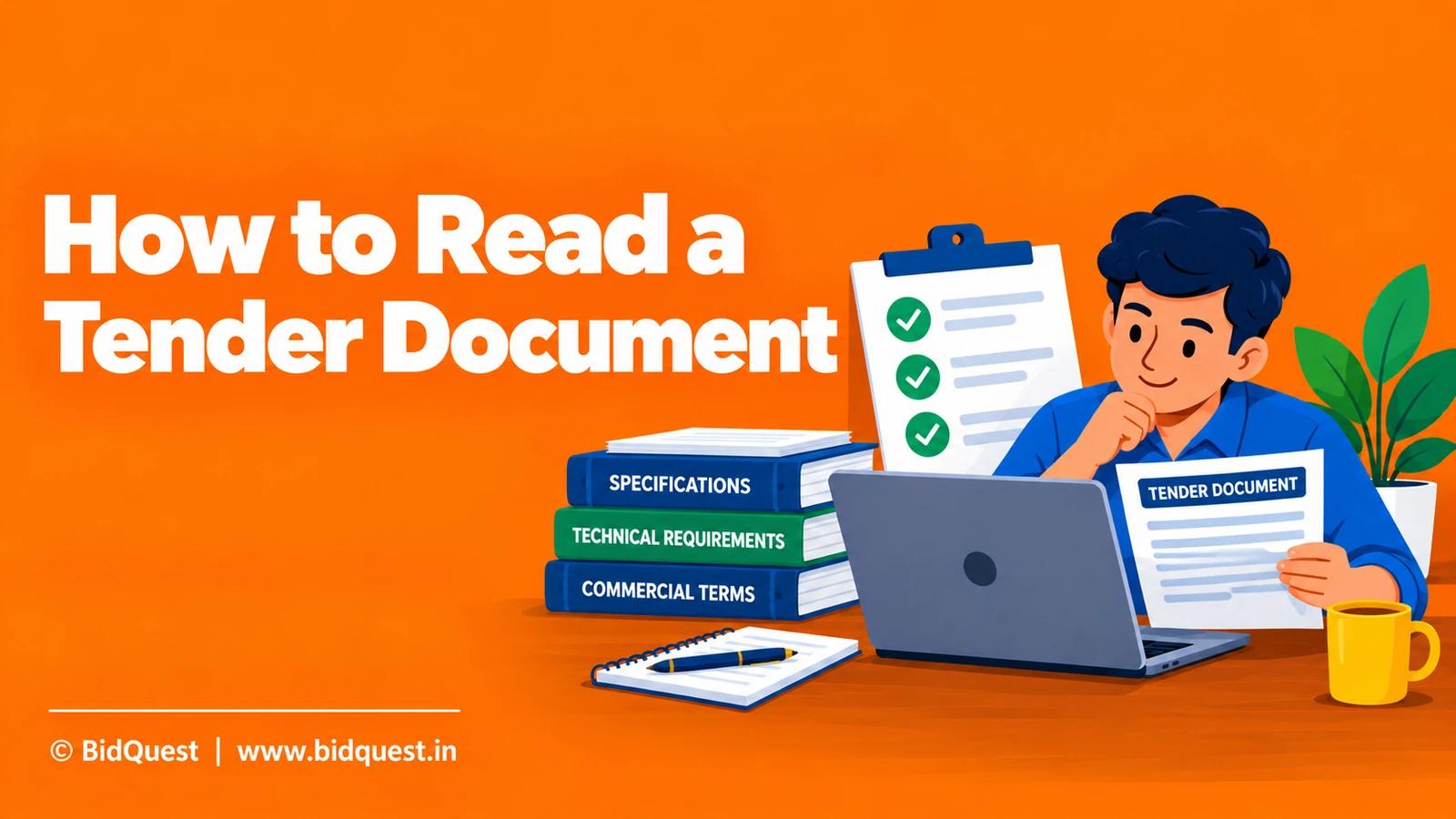
Learn how to read government tender documents in India: NIT, eligibility, technical specifications, BOQ, EMD, evaluation, corrigenda and submission checklist.
Read the guide
Learn how Indian MSMEs and contractors can find government tenders on CPPP, GeM and state portals, shortlist relevant notices and track corrigenda.
Read the guide
Government contracts can be commercially viable when the accepted price covers the complete obligation, financing needs and allocated risks.
Read the guide