SYSTEM // LOADING
BIDQUEST // 2026
GRID // 1280px
BIDQUEST // 2026
Zero manual search • 100% Free
Find the correct Rajasthan procurement route, check SHPP transition notices, and prepare evidence, fees and submission records for the actual tender.
During this run, the Rajasthan eProcurement portal displayed a notice titled “Mandatory Use of the Single Holistic Procurement Portal (SHPP) for Procurements with effect from 01.10.2026.” SHPP also provides official portal and manual pages. The full transition order was not retrieved, so this guide does not assume how every ongoing or legacy tender is handled. Observed legacy notice; SHPP; manuals.

Record the buyer, tender identity, official notice, designated platform, document location and bid submission route. Add the date on which the team verified them.
If an existing event appears on one system while a general notice refers to another, identify the event-specific instruction and obtain official clarification where necessary. Do not assume that a registration or saved draft automatically migrates.
The practical rule is to establish the route before investing time in screen-by-screen preparation. An otherwise complete offer cannot benefit from a submission made in the wrong place.

Build a search vocabulary based on the work you provide: road repair, electrical maintenance, equipment supply, cleaning or another specific service. Use several related terms rather than relying on one exact title.
When the organisation is known, examine its official notices and the platform they identify. For a continuing opportunity, use the tender reference and compare amendments rather than finding it again by title.
Keep archived records separate from active opportunities. A historical listing can explain buyer requirements without being an invitation to submit now.

Read qualification, scope, price schedule, securities, contractual terms, milestones and submission instructions together. Establish which document version and amendments apply.
For Rajasthan work, also determine the state procurement framework and any buyer-specific conditions relevant to the bid. Do not copy central procurement benefits into the estimate without checking applicability.
Use a requirement matrix: clause, required evidence, available file, responsible person and status. A familiar work type does not establish qualification for every tender.
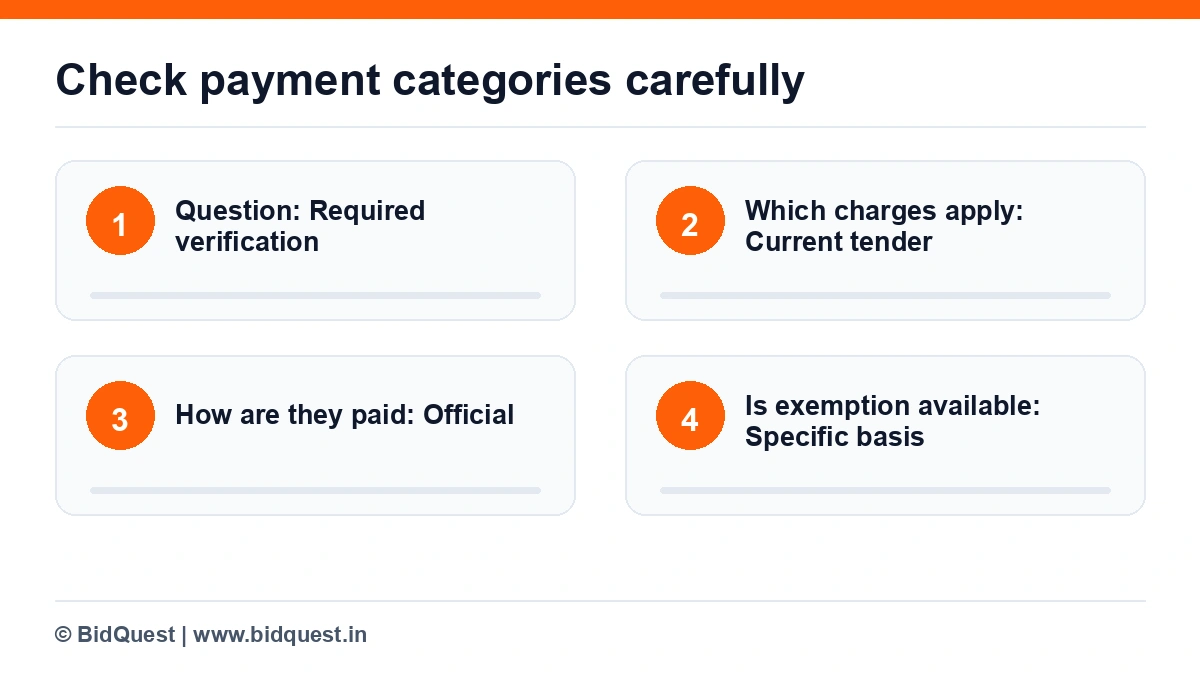
The legacy portal contains separate references to document fees, bid security and RISL processing fees. Treat these as verification prompts, not current rates or proof that the old payment mechanism applies to every SHPP event.
| Question | Required verification |
|---|---|
| Which charges apply? | Current tender and platform instructions |
| How are they paid? | Official method and recipient |
| Is exemption available? | Specific basis and evidence |
| What proves compliance? | Required receipt or instrument |
| Is an original required? | Actual submission instruction |
Assign finance to confirm payments and the coordinator to reconcile evidence. Do not reuse an older challan or recipient detail without checking the current event.
Rajasthan contracts can involve different districts, sites and access conditions. Assess travel, equipment movement, supervision, accommodation where relevant and local support based on actual locations.
For an illustrative two-site equipment supply, one site might need installation support several days after receipt. The estimate should include that visit if required, rather than treating both destinations as one delivery event.
Confirm dependencies and the required evidence for completion. An attractive tender value does not compensate for an uncosted operating plan.
Use the current official manuals for the designated system. Confirm account ownership, authorised signatory, supported signing process and access well before the deadline.
Do not rely on legacy button names to describe SHPP final submission. Use the live current procedure and retain the resulting acknowledgement.
If an account issue blocks readiness, raise it through verified support and tell the bid owner. Do not create duplicate or unofficial workarounds without reviewing the legitimate process.
A contractor finds a Rajasthan notice in a legacy search result and begins preparing files using an older submission guide. The official notice identifies a different current route.
The coordinator catches the mismatch during the route review, verifies the event instructions and prepares the account and file set for the correct system. Finance rechecks the stated payment method.
The example illustrates a prevention control. It does not state that every tender must move between systems or that unfinished bids are automatically transferred.
Check event identity, source version, amendments, payments, evidence, technical/commercial placement and signatory availability. Then complete the current platform's required final action.
Retain the final acknowledgement with the approved documents. After submission, monitor the same official event and designated communication route for subsequent action.
For a bid near a portal transition, ask the coordinator to produce a short route note before the commercial team approves full preparation.
The note should identify the issuing authority, event reference, observed portal instructions, relevant transition notice and any unresolved treatment. Save the official source rather than relying on a forwarded summary.
Have the bid owner confirm the route or assign a formal clarification. Mark the decision as verified or pending; do not treat an assumption as a completed check.
This control is useful because account, payment and submission work may depend on a route that changed after an older tutorial was produced.
A legacy system may still display records useful for history, comparison or an ongoing event. That visibility does not tell the team which action belongs there today.
For each procurement, record where documents were found and where the official notice says the bid must be submitted. If those differ, maintain both references with their roles.
Do not assume a deadline displayed in one record supersedes another without finding the relevant formal amendment or instruction. Resolve a material conflict through the designated authority.
The guide's observed transition notice is a prompt for that verification, not a substitute for the full governing order.
Identify the authorised user, legitimate contact channels, required signing arrangement and current instructions. Establish which preparation tasks the business can complete now.
If an existing account is expected to be usable, verify that position rather than assuming automatic migration. If a new process is required, follow official guidance and retain its confirmation.
Assign a backup coordination role for document and deadline tracking without distributing secret access. Business continuity should preserve control, not remove it.
Keep the readiness worksheet linked to the event so later bids can reuse reviewed information only where still applicable.
For a transitional procurement, compare the tender's stated fee, security and processing instructions with current official platform guidance. Identify any separate evidence or original requirement.
Do not use an old recipient, challan or amount simply because accounts recognises it. Have finance confirm what this event requires and how it will be reconciled.
If two sources conflict, ask a focused question before paying. Keep bank initiation, official confirmation and submitted evidence as separate checks.
The objective is a traceable payment path, not a guess based on the old platform's familiar screen.
Use actual locations rather than a broad Rajasthan coverage claim. Record the site's scope, access, receiving role, required resources and evidence.
For an illustrative supplier with two distant installation sites, transport may be only one part of the cost. Technical attendance, return visits and local replacement arrangements can matter too.
Estimate those tasks using real supplier and staffing commitments where possible. Do not infer travel practicality solely from a map distance.
If a site is unspecified, identify the uncertainty and ask for information before making a fixed all-inclusive commitment.
List every downloaded file, source, issue date and role in the bid. Keep amendments and formal responses linked to the clause they affect.
During a platform handoff, preserve the original record and add the new reference rather than overwriting the history. The team should be able to explain which version informed each approval.
If a BOQ or form changes, revoke outdated final status and re-review the affected content. Do not assume the file format remains identical across routes.
Give the uploader only the approved current-use set and keep working calculations separate.
Before the internal cutoff, confirm account access, authorized availability, correct event, final files and required payment evidence through legitimate readiness steps.
Do not submit a dummy offer or use unapproved workarounds to test the system. Read the current supported procedure and identify any remaining assistance needed.
Have the coordinator explain the final action and acknowledgement requirement to the bid owner. Familiarity with a legacy button does not establish knowledge of a new route.
If readiness remains unresolved, escalate it while there is time for the official support process.
An unresolved route, qualification gap or infeasible delivery plan can justify declining an opportunity. Record the specific reason instead of marking the tender generally unattractive.
That record can improve preparation for the next event: establish account readiness, gather missing credentials or clarify the operating footprint.
Do not treat the time already spent downloading documents as a reason to submit an uncertain offer. The business should pursue a bid it can prepare and deliver credibly.
The route-confirmation gate creates value even when its result is a disciplined no-bid.
Retain the actual acknowledgement, event reference, final files and any remaining prescribed action. Monitor communications through the officially designated channel.
If the event moves or further instructions are issued, preserve the decision trail and follow the applicable procedure. Do not assume internal submission status tells you every next step.
The final record should allow another authorised employee to continue the bid without reconstructing a portal transition from memory.
Confirm the designated route again before final submission if a material portal notice changes during preparation.
First verify the current event and route, particularly in light of the observed SHPP transition notice.
The full order was not retrieved here. Verify event-specific treatment and obtain official clarification when unclear.
No. Check the actual tender and current platform instructions.
Confirm the requirements of the designated system rather than assuming migration or equivalence.
Add route confirmation as the first row in every Rajasthan bid checklist. Explore BidQuest for discovery, then confirm and submit through the authority's current official route.
www.eproc.rajasthan.gov.in. Accessed 12 Oct 2026.
shpp.rajasthan.gov.in. Accessed 12 Oct 2026.
shpp.rajasthan.gov.in. Accessed 12 Oct 2026.
Learn how to read government tender documents in India: NIT, eligibility, technical specifications, BOQ, EMD, evaluation, corrigenda and submission checklist.
Read the guide
Learn how Indian MSMEs and contractors can find government tenders on CPPP, GeM and state portals, shortlist relevant notices and track corrigenda.
Read the guide
Government contracts can be commercially viable when the accepted price covers the complete obligation, financing needs and allocated risks.
Read the guide