SYSTEM // LOADING
BIDQUEST // 2026
GRID // 1280px
BIDQUEST // 2026
Zero manual search • 100% Free
Understand rate contracts, framework agreements, call-off orders, quantity uncertainty and supplier margin risk in government procurement.
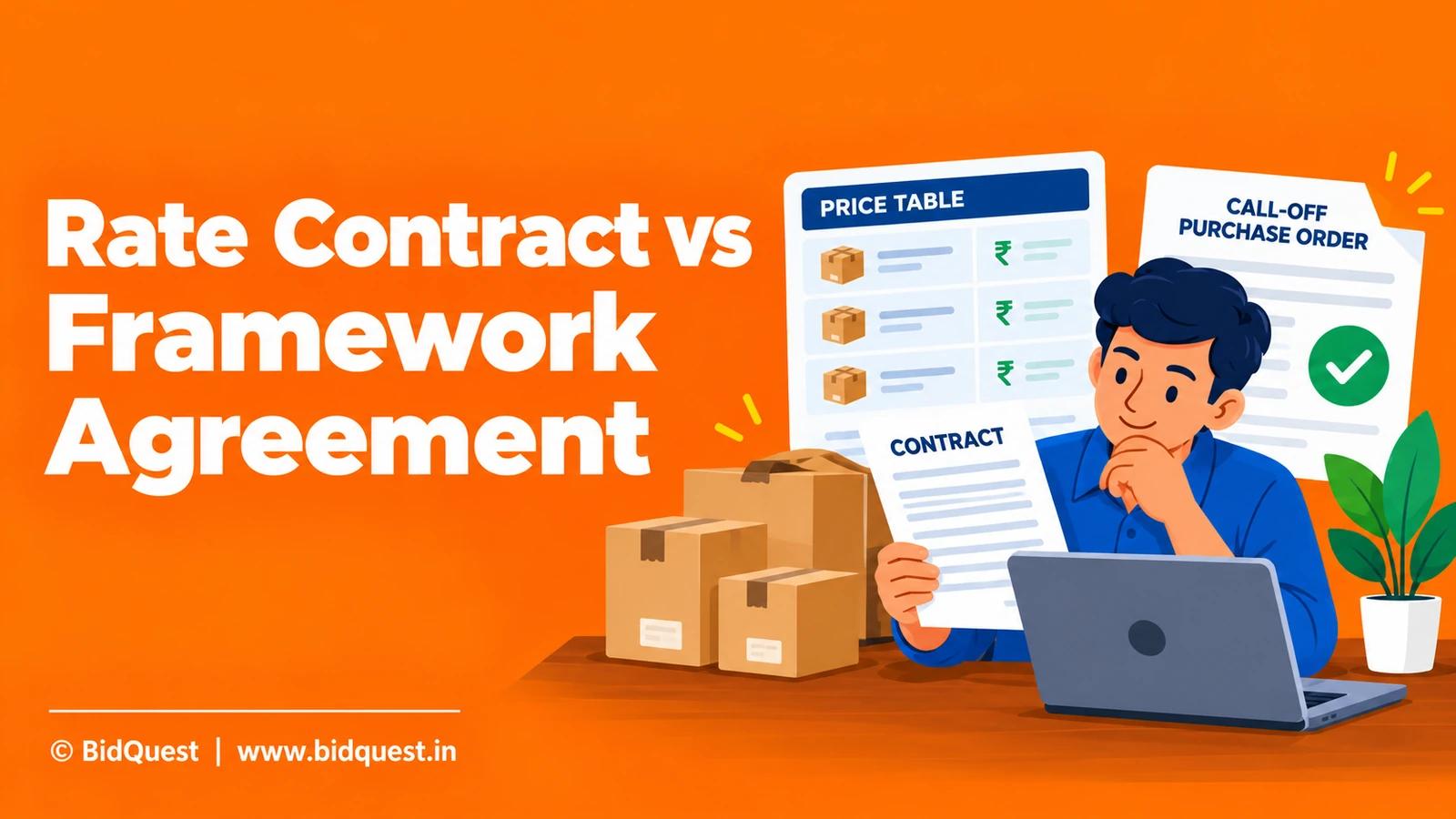
This guide is written for Indian suppliers, contractors, MSMEs and bid teams who need a repeatable decision process, not a shortcut around the buyer's rules. The issuing department's live notice, attachments, amendments and portal instructions control every submission. A general procurement manual explains a framework; it does not replace a particular tender. The examples below are hypothetical training examples, not quotations from real government bids.
The main question is rate contract vs framework agreement procurement. The answer depends on the exact procurement type, buyer, category, and tender wording. Keep a copy of the original tender with its version and publication date, note the clause number beside every decision, and ask the buyer through the permitted clarification channel where a requirement is unclear. Do not infer eligibility, price preference, contract award, or portal acceptance from this guide alone.
Buyers repeatedly purchasing common goods may prefer a framework that reduces the need to negotiate the same basic terms for each order. The Department of Expenditure's Goods Manual discusses Rate Contracts and Framework Agreements in section 4.4. The exact model varies: some arrangements identify one supplier, others more than one, and subsequent purchases may require a separate order or call-off. A supplier should understand which obligations arise when the framework is signed and which arise only after a specific order is placed. Do not import private-sector terminology into a government tender without reading the instrument's definitions.
A notice might estimate annual demand at 10,000 units, but actual orders may be lower, uneven or subject to budget availability. Before pricing, identify whether the buyer guarantees any minimum purchase, caps quantities or reserves the right not to order. If the tender gives historical demand, treat it as planning information unless it is a contractual commitment. A supplier that invests in inventory for the full estimate can face carrying cost and obsolescence when call-offs are delayed. Build three volume scenarios: low, expected and high. Record which costs remain fixed regardless of volume and which rise with each order.

A framework can define rates while each purchase order specifies quantity, destination and required delivery date. Review how orders are issued, acknowledged, amended and cancelled. Identify whether there is a minimum order size and whether multiple delivery locations are possible. A ₹500 unit price may be profitable for a truckload to one depot but not for ten-unit orders to remote sites. If the buyer can issue small orders without a minimum quantity, include realistic handling and logistics in the pricing model or clarify the terms before bidding. Do not refuse a valid call-off merely because the order is smaller than the internal forecast.
A fixed rate over twelve or twenty-four months can expose the supplier to input inflation, currency changes, freight increases and statutory cost variation. Check whether the agreement includes a price-variation formula, review date, escalation index or firm-price obligation. The Goods Manual addresses firm and variable prices in section 6.6, while later Department of Expenditure orders may affect index choices for future contracts. Do not assume a 2026 policy memorandum automatically changes an already signed agreement. Build a cost sensitivity table using reasonable scenarios, then compare the worst credible margin with the business's risk appetite.

Some frameworks may be non-exclusive or may include several suppliers. A bidder should identify whether it has any priority, whether the buyer can place orders elsewhere, and how individual orders will be allocated. A low rate offered in expectation of exclusivity can be dangerous if the buyer is free to use other suppliers. Read the order mechanism rather than relying on a procurement title such as "annual rate contract". If an allocation rule is unclear, ask the buyer to explain it in the formal clarification process. Avoid informal discussions with other suppliers about how future orders might be shared.
The rate may cover more than physical goods. Delivery, installation, replacement, warranty support, training or periodic maintenance can continue after the last order. Determine whether the warranty starts at delivery, installation, acceptance or another event for each call-off. Track individual order dates and warranty expiry separately. If the framework ends in December but the final call-off is delivered in November with a two-year warranty, the service obligation may continue well beyond the framework's ordering period. Price the full obligation and plan spare parts or service coverage accordingly.

A framework can create a strong sales pipeline while generating unpredictable cash receipts. Model inventory commitments, supplier payment terms, production lead times, inspection delays and buyer payment terms. Keep a rolling forecast based on actual call-offs rather than the original estimated value. If a supplier needs to maintain emergency stock, quantify its carrying cost and decide whether the contract compensates for it. Finance should track each order, invoice and acceptance separately to avoid mixing receivables. A monthly review can compare forecast, orders received, delivered quantities and unpaid invoices. That is more useful than celebrating the framework's maximum value.
Before accepting each order, verify it falls within the framework's validity, scope, rate, permitted quantity and delivery terms. Record the buyer's order reference and authorised signatory. Check whether the requested location or product variant is covered. If the buyer asks for a change, obtain a valid amendment rather than treating a telephone call as an order. Maintain a central register of call-offs, fulfilment, inspection and payment. When the framework nears expiry, identify outstanding orders and continuing warranty obligations. A controlled process turns an attractive tender award into reliable execution without overstating the revenue it will produce.

A hypothetical stationery supplier signs a one-year rate arrangement at ₹85 per box for an estimated 40,000 boxes. The team initially treats ₹34 lakh as guaranteed revenue. The agreement, however, states no minimum purchase commitment and allows orders to multiple locations. In the low-demand scenario only 12,000 boxes are ordered, generating ₹10.2 lakh of gross sales before taxes and other adjustments. A large upfront inventory purchase would tie up cash. The supplier instead negotiates flexible stock replenishment with its wholesaler and builds per-order freight assumptions into the permitted price model. It tracks every call-off separately and confirms whether the framework allows rate changes. The lesson is to value a framework as an ordering opportunity, not as a firm purchase order for the estimated quantity.
| Review point | Evidence to inspect | Practical decision |
|---|---|---|
| Quantity promise | Framework and minimum order clause | Separate estimate from commitment |
| Call-off mechanism | Order and allocation terms | Define fulfilment triggers |
| Price exposure | Rate validity and adjustment clause | Model inflation sensitivity |
| Delivery economics | Order size and locations | Price small orders realistically |
| Receivables | Inspection and payment terms | Forecast cash by actual orders |
A table is a decision aid, not a substitute for the actual document. Write the tender reference, clause and amendment date against every row in your working copy. If a requirement cannot be verified, mark it unresolved and assign an owner; do not quietly treat it as satisfied.
Treat the checklist as a living record. Assign each line to one person, attach the source file, and record when it was checked. On the final submission day, re-open the official portal to confirm whether a corrigendum, revised schedule, or changed attachment supersedes your saved copy. Keep the submission acknowledgement or contract communication in the tender folder.
The first mistake is confusing a helpful summary with an authoritative instruction. Search results, aggregator cards and internal spreadsheets may omit exceptions or later amendments. The second is assuming that a rule applicable to central government goods procurement applies identically to works, services, state tenders and GeM bids. The third is allowing the commercial team to quote before the technical owner has confirmed scope and acceptance criteria. The fourth is treating an unsigned internal note as evidence that a buyer accepted a deviation. The prevention is straightforward: cite the live tender clause, preserve the original file, and use written official clarification when necessary.
BidQuest is a private SaaS tender-discovery and review aid, not GeM, CPPP, a state e-procurement portal, or a government authority. Its public website describes tender search and matching features. You can use BidQuest to explore potentially relevant opportunities and then carry out the checks in this article against the buyer's original documents. BidQuest does not issue eligibility certificates, grant exemptions, approve bid documents, submit an official bid for you, or guarantee a tender award. For a useful starting point, see our published guides to finding government tenders and reading tender documents.
Optional next step: Explore tender opportunities on BidQuest, then verify the original notice on the official procurement portal.
Not necessarily. Read the specific minimum-quantity and ordering clauses.
No. The actual contract determines whether multiple suppliers or other sourcing are permitted.
Only as allowed by the agreed price-adjustment or amendment provisions.
Follow the applicable contract and each order’s acceptance or delivery trigger.
The following primary sources were checked on 11 October 2026. The named section or course identifies where to verify the relevant principle. Always check later amendments and the live tender.
Editorial status: draft, not approved for publication. Technical and legal conclusions must be checked against the applicable tender and current government instructions before release.
Department of Expenditure. Accessed 11 Oct 2026.
Department of Expenditure. Accessed 11 Oct 2026.

Learn how Indian MSMEs and contractors can find government tenders on CPPP, GeM and state portals, shortlist relevant notices and track corrigenda.
Read the guide
Learn how to read government tender documents in India: NIT, eligibility, technical specifications, BOQ, EMD, evaluation, corrigenda and submission checklist.
Read the guide
Government contracts can be commercially viable when the accepted price covers the complete obligation, financing needs and allocated risks.
Read the guide