SYSTEM // LOADING
BIDQUEST // 2026
GRID // 1280px
BIDQUEST // 2026
Zero manual search • 100% Free
Search Tamil Nadu tenders, check state and buyer-specific requirements, reconcile documents and amendments, and plan delivery and final submission.

The Tamil Nadu eProcurement portal includes active tenders, organisation and location browsing, corrigenda, results, bidder-help resources and a link labelled TN Tenders Act. Official portal.
The presence of a state framework is a reason to verify applicability, not to import rules from a different state or a central procurement without review.

Use product or service terms alongside likely organisations. For a known opportunity, use tender ID and reference to distinguish similar notices.
The public listing can contain several entries with the same title. Compare identity, location and work details before treating them as duplicates.
Keep the authority's specified route in the shortlist. Not every procurement physically located in Tamil Nadu necessarily uses the same portal.

Save invitation, instructions, qualification, scope, contract terms, BOQ and amendments together. Identify which version controls each requirement.
Where documents use different languages or technical terminology, obtain a competent review of the actual meaning. Do not rely on automatic translation for a consequential clause without checking it.
If conflicting language versions or documents create uncertainty, use the tender's precedence provisions and formal clarification process with appropriate specialist advice.

Create a matrix for the actual experience, turnover, registrations, licences and technical records requested. Assign evidence files and reviewers.
| Check | Reviewer question |
|---|---|
| Experience | Does the certificate prove the defined completed scope? |
| Financial | Are the specified years and basis represented? |
| Technical | Does the proposed configuration meet requirements? |
| Identity | Do the records belong to the bidding entity? |
| Benefits | What policy applies to each specific claim? |
Do not assume registration waives every qualification or security. Review individual applicability against the actual framework and event.

Determine sites, access hours, quantities, installation, support and any recurring obligations. Add transport and service arrangements that the contract actually needs.
For an out-of-state supplier, consider how technical staff will reach a site and handle replacements. For a local company, check whether distant destinations exceed its normal operating footprint.
Use supplier commitments and realistic schedules rather than a general statement that the whole state can be served.
A contractor sees several entries labelled similarly and saves only the first. The detail review shows different locations and separate tender identities.
The team restores the correct shortlist, evaluates each scope separately and avoids reusing the wrong BOQ or security reference. Finance examines whether simultaneous awards would exceed working capital.
The example demonstrates why stable identity matters. Similar wording does not establish one procurement or interchangeable documents.
Use the portal's corrigendum route and the specific event record. Keep an impact log with clause, revised requirement, affected file and owner.
If the amendment changes quantity, work period or technical specification, ask finance and operations to review the new assumption. Do not update only the date.
Keep formal query responses with the tender package. A convenient interpretation from a phone call should not replace the required official record.
Follow the current official account, signing and file instructions. Confirm the authorised signatory and actual workstation before the final day.
Prepare a final file index showing what belongs in each cover or upload location. Reconcile payment and security evidence with the correct tender.
Set a practical internal cutoff that permits review and troubleshooting. Do not assume the portal will accept a late offer because your files were prepared on time.
Have a second person compare final files with the requirement matrix. Check readable scans, prescribed forms, relevant dates, identity and commercial separation where required.
Then complete the current portal submission procedure and retain the acknowledgement. Keep the actual final files and submission evidence together.
A system receipt and a content review answer different questions: whether the offer was received and whether the prepared evidence addresses the requirements.
Assign someone to monitor official status and communications. If selected, hold a contract handover covering delivery, funding, securities, evidence and invoicing.
Avoid rebuilding the operating plan from memory after award. Preserve approved bid assumptions and compare them with the confirmed contract.
When several entries have similar wording, compare tender IDs, references, locations, lots and issuing units. Keep separate rows until their identity is established.
Do not merge them merely because the title and estimated value look alike. They may require separate offers, securities or delivery plans.
Likewise, do not count a retender as an entirely unrelated opportunity without checking its relationship to the earlier record. Preserve the history where it helps explain amendments or changed requirements.
The shortlist should support correct document selection rather than inflate the number of apparent leads.
Identify the documents and clauses requiring competent interpretation. Keep the original text with any working translation and name the reviewer.
For a consequential conflict, use the actual precedence provision and formal clarification route with appropriate advice. Do not choose the version that creates the easiest eligibility claim.
Avoid submitting a declaration based only on automatic translation if the underlying obligation remains uncertain. Translate the meaning into a verifiable action in the requirement matrix.
The goal is a correct offer, not a confident-looking English summary detached from its source.
Record which procurement framework and buyer instructions govern the event. Where a benefit or procedure is unclear, identify the specific provision and request the relevant treatment.
Do not import an MSE, security or fee rule from another procurement simply because the enterprise used it previously. Each claim needs an applicability basis.
Have finance model required payments while the policy reviewer checks relief. Keep confirmed and unresolved amounts separate.
This avoids both missed legitimate benefits and unsupported assumptions about waiver.
For a hypothetical equipment order, suppose one site needs installation and another needs receipt only. Separate the resource and evidence plans.
The installation site may require power readiness, testing and training. The other may have different delivery access and quantity records. Do not copy a single checklist without reviewing relevance.
Ask suppliers to confirm availability and support for the entire commitment. Include any continuing site attendance in the cost model.
A correct address list is useful, but the operating plan must describe what happens at each address.
If the team prepares several Tamil Nadu opportunities, map supplier payments, mobilisation, securities and staffing on one calendar.
Two bids can be individually affordable yet difficult to operate together. Do not assume the business will win only one when approving exposure.
Use a clearly labelled combined-award scenario and ask management which capacity is genuinely available. Identify subcontracting or supplier arrangements only where permitted and confirmed.
The purpose is a credible portfolio decision rather than an optimistic sales forecast.
Retain the original price file and an approved final working version. Use a clear internal reference so similar tenders do not receive each other's commercial document.
Check units, quantities, tax assumptions and inclusions against the scope. If the format conflicts with a requirement, raise a formal question instead of redesigning it.
When an amendment supplies a replacement file, revoke the old upload-ready status. Reconcile the new price with the approved cost model.
The final reviewer should open the actual intended attachment, not rely on a familiar filename.
Identify the required inspection, measurement, service, testing or handover records. Assign the producing and approving roles.
For recurring work, align record periods with billing. For supplies, reconcile quantities and configuration. For site work, retain the measurement and authorised variation evidence actually required.
Do not assume a photograph or a general receipt replaces a prescribed acceptance record. The evidence plan must follow the contract.
Prepare the template and responsibility before deployment so records are produced while the work happens.
Use separate milestones for screening, questions, supplier confirmation, technical review, finance approval and final submission. Set dates earlier than the official cutoff where practical.
If a material answer arrives late, assess whether the bid can still be reviewed properly. Do not erase the review task to preserve an optimistic completion promise.
The authorised uploader needs the final document index, current instructions and available signatory. Keep technical troubleshooting visible as a readiness issue.
This calendar gives a small team a manageable sequence without creating a large administrative process.
Save official status and relevant communications after submission. Distinguish qualification, ranking and award where the process does so.
Do not invent reasons for rejection or detailed scores that the buyer did not disclose. Use the available evidence to identify improvements.
If selected, transfer confirmed scope and assumptions to the delivery team. If not, close relevant financial and document obligations.
The tender record should explain the actual outcome while preserving uncertainty honestly.
When several Tamil Nadu tenders have repeated titles, keep their tender identities, price files, security references and approved evidence clearly separated. Reusable company records can be shared through a controlled index, but the actual final offer must remain event-specific.
Have the reviewer open the intended BOQ and compare quantity and scope against that tender. Do not infer correctness from a familiar filename or from having completed a similar bid the same day.
After submission, retain each acknowledgement with its own file set and follow-up owner. If one event is amended or retendered, record that relationship without overwriting another offer's history. A clean identity control reduces commercial mistakes while allowing the team to reuse genuine evidence efficiently.
After a formal amendment, notify the specific reviewer responsible for each affected file. Merely placing the amendment in a shared folder does not establish that eligibility or pricing was reconsidered.
Use the state portal and the relevant issuing organisation's record.
Compare IDs, locations, lots and scope first.
Obtain competent review and use formal clarification for consequential ambiguity.
Confirm the governing framework and the actual tender treatment.
Follow the current final action and retain the official acknowledgement.
Choose one tender and prepare its identity, qualification, location and amendment records. Explore BidQuest for discovery, then verify and submit through the official route.
tntenders.gov.in. Accessed 12 Oct 2026.
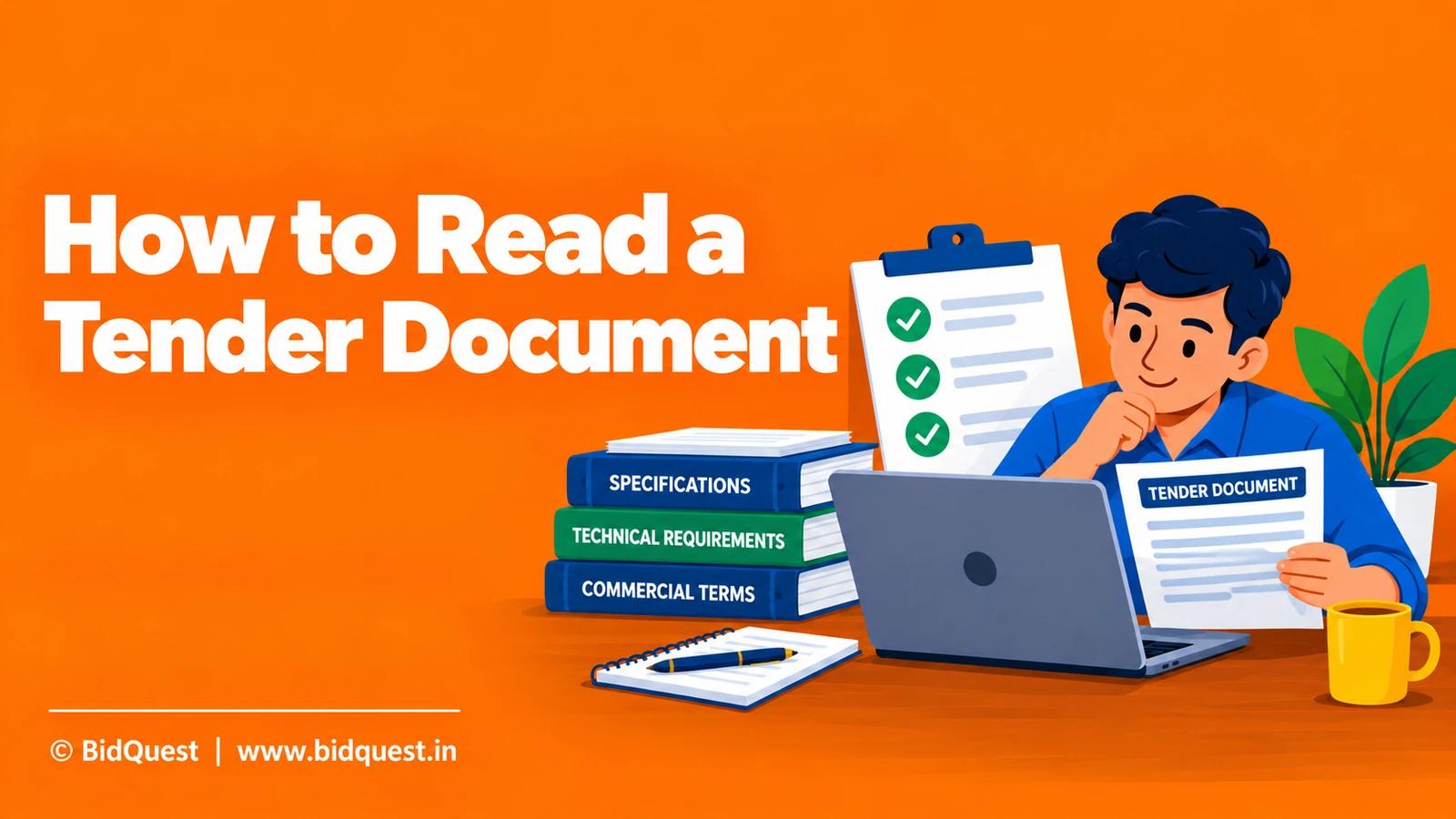
Learn how to read government tender documents in India: NIT, eligibility, technical specifications, BOQ, EMD, evaluation, corrigenda and submission checklist.
Read the guide
Learn how Indian MSMEs and contractors can find government tenders on CPPP, GeM and state portals, shortlist relevant notices and track corrigenda.
Read the guide
Government contracts can be commercially viable when the accepted price covers the complete obligation, financing needs and allocated risks.
Read the guide