SYSTEM // LOADING
BIDQUEST // 2026
GRID // 1280px
BIDQUEST // 2026
Zero manual search • 100% Free
Review the official rejection information and the relevant requirement in the submitted package before forming an explanation.

Read the particular bid and any auction conditions as one controlled commercial process. Determine what must be qualified or fixed before a price competition, who may proceed and which actions create a final commitment. The operator needs an approved scope and price limit, not merely a login. Technical preparation, commercial approval and authority to release should be explicit, even when the same person performs several tasks in a small business.
Preserve the complete package and relevant amendments and verify the current submission stage. A price rank, successful upload or saved draft does not necessarily establish the same fact as qualification, final release or award. Clarification should stay within the authorised process and should not be assumed to permit an unrestricted new offer. If an entry or access problem occurs, retain accurate timing and evidence and seek official support without inventing an automatic correction or deadline extension.
A fictional auction operator sees competitors reduce their prices and reaches the company's authorised floor. The next permitted reduction would create an unapproved commitment. Instead of assuming savings can be found later, the operator follows the agreed stop and escalation arrangement. No real margin, auction rule or outcome is asserted. The example shows how a pre-approved commercial basis can guide a pressured decision without treating a favourable rank as proof the contract will be profitable.
| Question | Evidence to review |
|---|---|
| Participation | Actual event rules and current qualifying status |
| Scope and price | Approved configuration and complete cost basis |
| Operator authority | Release limits and escalation responsibility |
| Result | Official acknowledgement, stage and outcome evidence |
At handover, explain what the bidder actually committed and what remains pending. This prevents sales, operations and finance from acting on different assumptions about an event whose displayed status may concern only one stage of the procurement.
Look for the official submission status and acknowledgement required by the actual GeM event, recording the bid number, time and released version. Saving a draft, uploading attachments and completing final submission can be separate steps. Check that required documents and the approved commercial response correspond to the acknowledged offer. A screenshot of an upload screen is weaker evidence than the system's relevant completion record. If status is ambiguous, promptly use official support and preserve the facts without assuming the deadline will be extended. The team needs to establish that the intended offer was released, while recognising that submission does not itself establish qualification or award.
Use the official GeM event record and authorised notifications to track the relevant technical, financial and award stages. Record what each status actually establishes and what remains pending. Bid opening does not necessarily mean technical qualification, and a financial position does not necessarily mean award. Keep clarification requests and deadlines visible to the responsible owner. If information is unavailable, use a permitted enquiry instead of treating silence as rejection or success. A controlled stage log supports resource planning without overstating certainty. Preserve the final official decision separately from internal forecasts so pipeline reporting reflects evidenced procurement progress rather than assumptions based on elapsed time.
Equal quoted prices are handled under the actual event's evaluation and tie-resolution provisions. Do not assume every GeM procurement uses the same ranking method or that being first to submit always controls. Read relevant conditions and authoritative communications for the particular item or package. Keep purchase-preference and other applicable treatment distinct from a simple numerical tie. If the result is unclear, seek the permitted explanation based on the documents rather than relying on another seller's anecdote. The business should preserve the offered price and official outcome, while avoiding unsupported claims about why a competitor received the award or how a tie will necessarily be resolved.
L1 status generally identifies a lowest-priced position on the relevant evaluation basis, not an unconditional promise of award. The buyer still follows the applicable qualification, evaluation, approval and procurement provisions. A displayed rank can also concern a particular stage or item rather than the complete package. Verify the official result and actual award communication before committing resources as though an order exists. Review your own cost and delivery assumptions even after a favourable rank. Winning at an unsustainable price does not make the business case sound, and an agent's claim that L1 guarantees payment should not replace the authorised procurement record.
Your auction floor should come from a complete cost and cash assessment of the actual contract, including supply, logistics, service, financing and relevant risk exposure. Competitor behaviour does not establish what your business can afford. Record an approved minimum and make clear who can change it. Use the same scope and unit basis as the auction so a low number does not conceal omitted obligations. Do not assume profit can be recovered through unauthorised substitutions, later price increases or unapproved extra items. A disciplined decision to stop bidding can protect the business when the next reduction would create a commitment it cannot sustainably perform.
Some reverse-auction arrangements provide an extension mechanism when specified bidding activity occurs near a scheduled close. Whether and how it applies must be read from the actual event conditions. Do not assume a universal extension period or that a clock reaching the originally advertised time proves completion. Plan operator availability, approvals and communications around the permitted process, and monitor the authoritative event status. Keep the approved price floor unchanged unless an authorised owner genuinely reapproves the commercial position. Timing uncertainty should not become pressure to make an unreviewed final reduction or a claim that an event continuing under its stated rules is necessarily defective.
An ordinary bid stage generally establishes the offered technical and commercial response under its submission instructions, while a reverse auction concerns a separately defined competitive price process. Their relationship depends on the particular procurement. Read what remains fixed, who may participate, how price changes are made and what happens after the auction. Do not assume technical commitments can be revised merely because prices are being competed. Plan the approved offer and auction floor together so the operator does not promise a loss-making or differently scoped supply. The names describe different process functions; the actual rules establish the consequences of each action and final result.
Participation in a GeM reverse auction depends on the applicable event rules and any preceding qualification or invitation conditions. Seller registration alone does not necessarily establish access. Check the official notice, current status and authorised communication identifying who may proceed. Prepare the required operational and commercial arrangements before the event, including a tested login and approved price limit. Do not assume a reseller, manufacturer or previous bidder has automatic participation rights across all auctions. If eligibility or access is unclear, seek official clarification in time. An auction screen should not be used to test an unsupported assumption that the business is entitled to participate.
A reverse auction is a defined competitive pricing stage in which eligible participants submit price changes under the event's rules. Read participation, timing, decrement, extension and finality conditions for the actual auction rather than assuming every GeM event operates identically. Approve a sustainable price floor from the complete cost and obligations before joining. Assign the operator clear authority and escalation limits. A lower displayed rank does not establish a profitable contract or a guaranteed award. Preserve relevant event records and treat accidental entries through the authorised process. The objective is disciplined pricing within the approved commitment, not continuing downward solely to remain competitive.
Use the price fields or financial schedule specified for the GeM event, on the required unit, quantity and tax basis. Review included delivery, installation, support and other obligations before approving the number. Do not assume an internal catalogue price automatically covers the bid's complete scope. Check arithmetic and the relationship between unit rates and totals, following any restrictions on alternative offers or discounts. Obtain the required commercial approval before release and preserve the submitted version. A later dashboard edit should not be assumed to revise an already committed offer, so pricing errors need the actual authorised correction or withdrawal process rather than informal promises.
These official resources are starting points for checking the applicable process. Confirm the current notice, attachments, corrigenda and portal instructions for your own opportunity. A general explanation cannot establish eligibility, an exemption or acceptance for a particular bid. Historical manuals and registration guides may differ from a current screen or contract.
Explore opportunities with BidQuest. Compare a suitable notice with your documented capability before committing money, approving a price or submitting a bid.
Department of Expenditure. Accessed 7 Nov 2026.
Government e Marketplace. Accessed 7 Nov 2026.
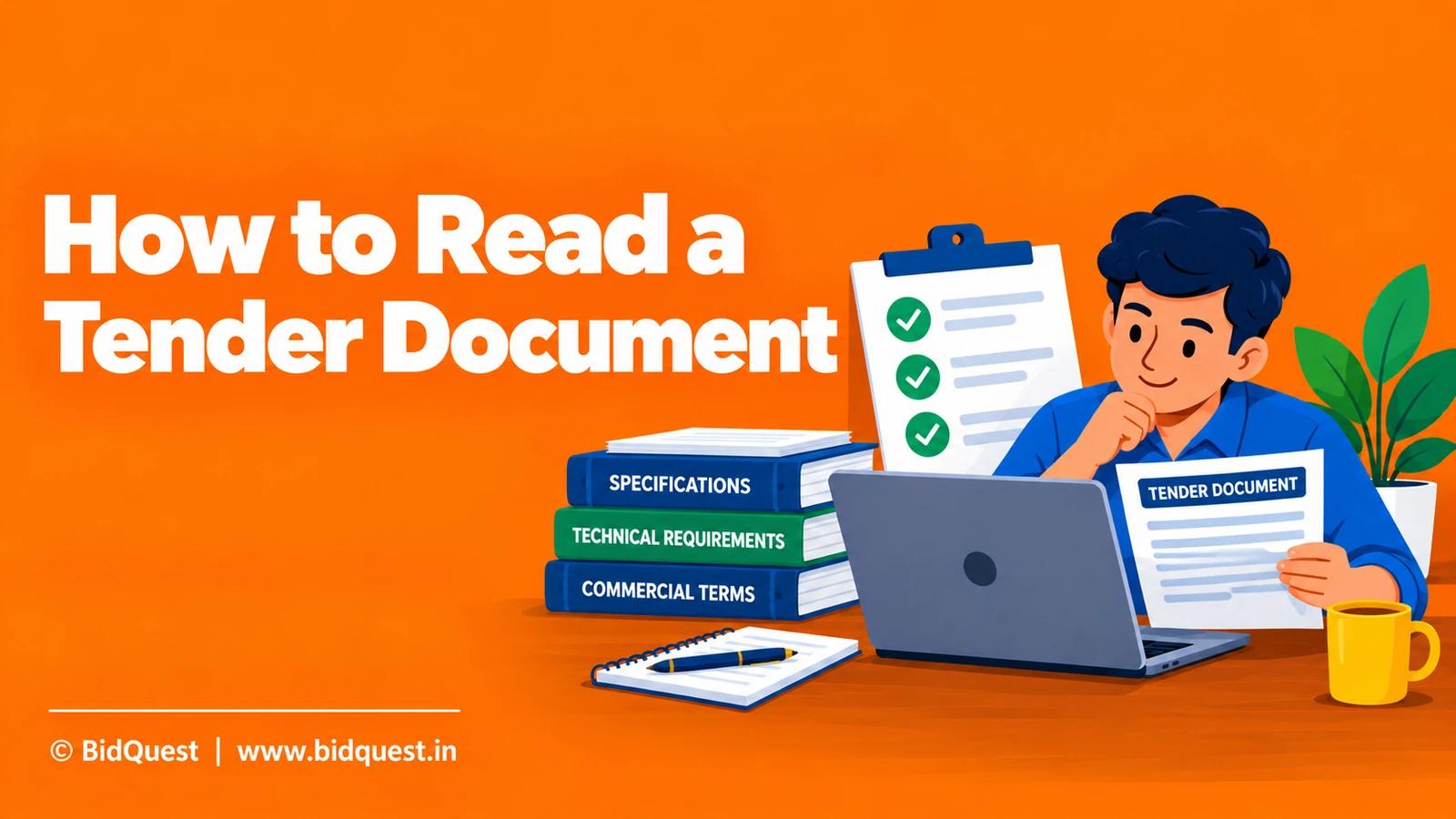
Learn how to read government tender documents in India: NIT, eligibility, technical specifications, BOQ, EMD, evaluation, corrigenda and submission checklist.
Read the guide
Learn how Indian MSMEs and contractors can find government tenders on CPPP, GeM and state portals, shortlist relevant notices and track corrigenda.
Read the guide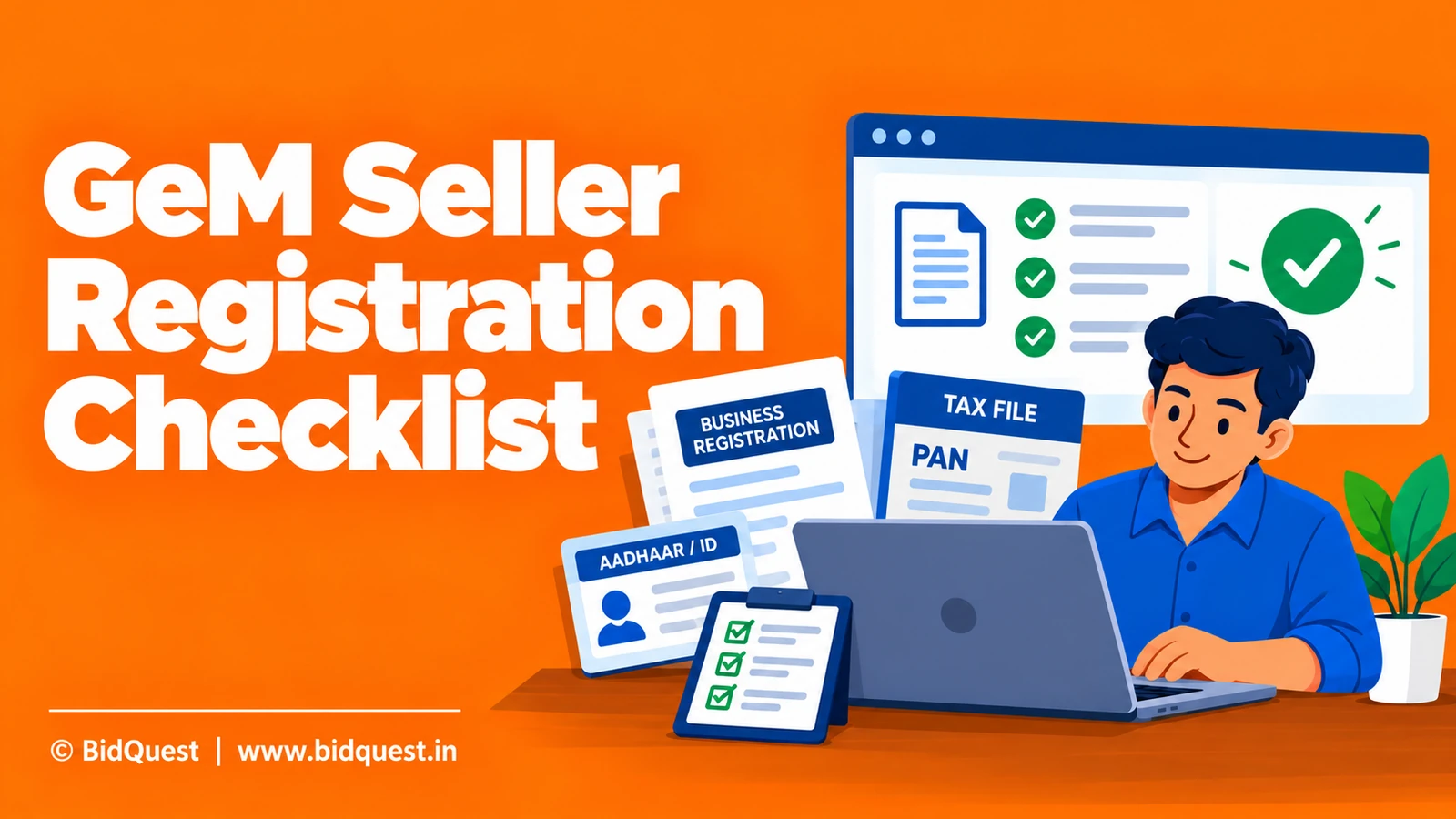
Prepare a GeM seller registration information checklist covering account ownership, business profile, tax details, authorised signatory and catalogue readiness.
Read the guide