SYSTEM // LOADING
BIDQUEST // 2026
GRID // 1280px
BIDQUEST // 2026
Zero manual search • 100% Free
Official GeM registration material describes seller registration as free.
Account creation, business validation and readiness for an actual transaction are different stages. Start with the genuine legal or business identity and the person entitled to represent it. Compare underlying records before entering information, especially where a trade name differs from an individual's or entity's formal name. A validation error should trigger investigation of the actual mismatch, not a succession of invented spellings, borrowed identifiers or duplicate accounts.
Establish long-term control of the authorised phone, email and recovery process. An outside preparer can assist with agreed tasks without becoming the only person able to access the business account. Record who approves profile changes and who may make commercial commitments. Review pending orders or bids before changing information that may affect them. Current official guidance should determine the actual steps; a historical video is context rather than proof of today's menu, charge or verification requirement.
A fictional seller's account was created using a consultant's personal email. When the consultant leaves, the owner discovers that recovery and notices depend on that address. The business follows the legitimate authority and support process to restore control and document the handover. It does not create another identity to conceal the problem. This example explains an access dependency; it does not establish the precise recovery procedure or processing time applicable to a real account.
| Question | Evidence to review |
|---|---|
| Seller identity | Current genuine business and verification records |
| User authority | Authorised representative and scope of actions |
| Account continuity | Business-controlled contacts and recovery arrangements |
| Application progress | Actual status, pending action and official reference |
After any material correction, check the relevant completion status and keep the record. A successful profile update should not be described as product approval, tender qualification or an award unless separate authoritative evidence establishes that later stage.
Check GeM's current seller-registration conditions for the proposed business type and the person authorised to represent it. Seller onboarding is different from qualification for a particular bid or approval of a product catalogue. Prepare accurate personal verification, business identity, address and banking information as applicable to the live workflow. A consultant can assist without becoming entitled to supply inaccurate details or control the business's credentials. Verify the official portal independently before entering sensitive information. After registration, review the actual product or service category and event conditions; an account establishes access to the marketplace, not a blanket approval to sell every item or receive orders.
There is no universal completion time that should be promised for every GeM registration. Progress depends on accurate data, identity and business validation, required actions and the current official process. A successful initial signup can be different from a completed profile or approved catalogue. Track which stage is actually pending and whether the business needs to correct information, supply evidence or await review. Preserve application references and use the official support route where appropriate. Do not pay for a guaranteed timeline that the intermediary cannot control. Plan bid participation around established readiness, rather than assuming that an account will be fully usable before a nearby submission deadline.
An individual should identify the business form under which they propose to sell and check GeM's current eligibility and onboarding instructions for that arrangement. Do not confuse an individual's verification as the authorised user with the separate identity of the seller. Personal access, sole-proprietor business activity and authority to represent another entity are different situations. Prepare consistent records and establish any relevant tax or licensing obligations. Portal acceptance is not a substitute for legal capacity or qualification in a specific bid. If the proposed arrangement does not fit the available official workflow, seek an authoritative explanation rather than borrowing a company identity or selecting an inaccurate constitution.
Find the account or seller identifier in the current official GeM profile, dashboard or authorised account communication. Keep it separate from a particular bid number, order number or an intermediary's customer reference. Record the identifier together with the correct business name and authorised account owner. This makes support requests and buyer communications easier to match to the right entity. Do not publish credentials or verification codes while trying to share an identifier. If multiple numbers appear, establish what each represents before inserting one into a tender form. An accurate account reference supports administration without proving the seller meets the conditions of the procurement being considered.
Prepare the information required by the current official GeM workflow for your business constitution and authorised user. Official onboarding material identifies identity verification, contact details and completion of relevant business, address and bank information, followed by product or service listing. Additional records can be relevant to profile validation, claimed benefits or the proposed procurement. Keep names and identifiers consistent with the issuing databases. Do not assume that entering a number is equivalent to verifying every underlying credential, or that an agent's universal checklist applies to every entity. Review the live requirement and preserve accurate source records without sharing unnecessary sensitive data with unrelated intermediaries.
Log in through the verified official GeM route and review the current account or application status relevant to the stage you completed. Distinguish user creation, profile validation, catalogue review and qualification in a bid. Record any pending action or validation message rather than reducing every stage to registered or not registered. Use the application or account reference when seeking support, keeping sensitive information limited to what the authorised process needs. If an agent created the account, obtain proper access and a complete handover. A screenshot supplied by the agent should not be the only evidence of the business's actual onboarding status or remaining obligations.
Use the current official GeM account interface and guidance to locate whatever seller-registration record or downloadable evidence the platform presently provides. Do not assume an agent-produced certificate is an official document, or that a tutorial's old menu remains current. Check the seller identity and relevant status on any downloaded record and retain its source and date. If a buyer requests a particular registration certificate, establish what evidence that requirement actually accepts. Seek official support when the expected document is unavailable rather than manufacturing a substitute. Registration evidence should not be presented as proof of product approval, bid qualification or a guaranteed government purchasing relationship.
After GeM signup, complete and validate the business profile, establish appropriate account control and review the products or services the business can genuinely offer. Prepare catalogue evidence and learn the official bid and order workflows before pursuing a time-sensitive opportunity. Registration does not replace category requirements, product approval or event-specific qualification. Build a simple operating record covering responsible people, source documents, costs and delivery resources. Review current official guidance rather than assuming orders arrive automatically after onboarding. The useful next milestone is readiness to submit and perform a suitable offer, with authority, cash and support arrangements established before the buyer makes a commitment.
Do not treat the ability to create a GeM account without entering a GSTIN at a particular step as proof that all later supplies can be made without GST registration. Establish the business's actual tax obligations and GeM's current profile, catalogue and transaction requirements. Then check the individual bid and proposed invoicing arrangement. The answer can depend on the entity and supply, so avoid a universal exemption claim based on an old tutorial. Use the correct business identity and obtain competent tax advice for consequential questions. Another person's GST number is not a legitimate substitute for resolving your own status or an incomplete profile requirement.
For a proprietorship, establish the correct relationship between the proprietor's identity and the business or trade name before starting GeM onboarding. Use the official seller route and current instructions for that constitution, verifying contact and applicable profile information with genuine records. Do not select a company form merely because a tutorial uses it. Check banking, tax and address consistency and resolve mismatches at their actual source. Keep control of credentials and verification messages with the authorised owner. Registration should be followed by appropriate product or service setup and review of bid conditions; completing the signup form alone does not establish qualification for future orders.
These official resources are starting points for checking the applicable process. Confirm the current notice, attachments, corrigenda and portal instructions for your own opportunity. A general explanation cannot establish eligibility, an exemption or acceptance for a particular bid. Historical manuals and registration guides may differ from a current screen or contract.
Explore opportunities with BidQuest. Compare a suitable notice with your documented capability before committing money, approving a price or submitting a bid.
Department of Expenditure. Accessed 7 Nov 2026.
Government e Marketplace. Accessed 7 Nov 2026.

Learn how to read government tender documents in India: NIT, eligibility, technical specifications, BOQ, EMD, evaluation, corrigenda and submission checklist.
Read the guide
Learn how Indian MSMEs and contractors can find government tenders on CPPP, GeM and state portals, shortlist relevant notices and track corrigenda.
Read the guide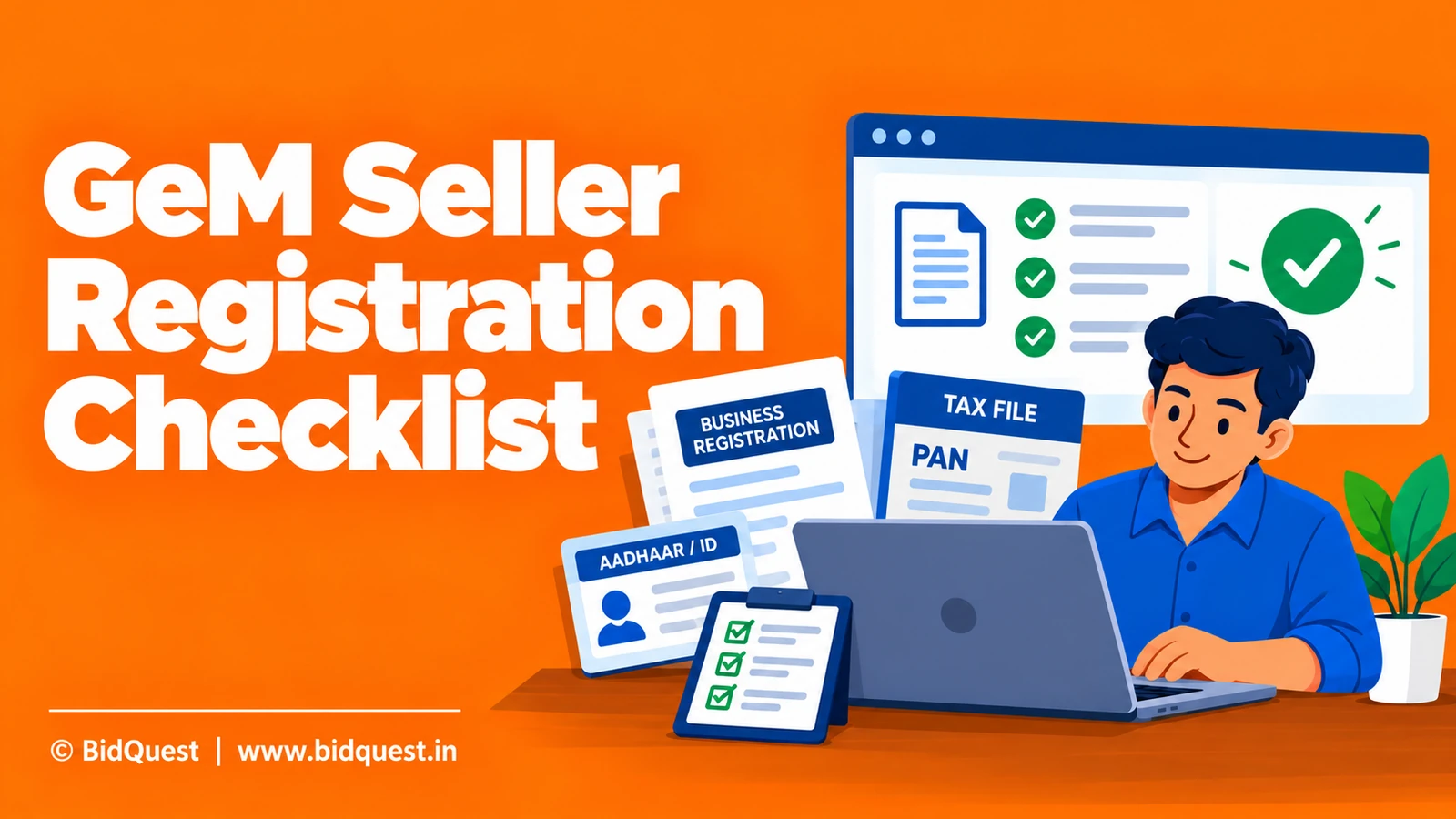
Prepare a GeM seller registration information checklist covering account ownership, business profile, tax details, authorised signatory and catalogue readiness.
Read the guide